
Bridal Portrait: How I Crafted This Frame (and Why It Works)
When I photograph an Old Mill Toronto Wedding, I’m always watching for the quiet pocket of time where the day briefly slows down—where the bride can breathe, reset her shoulders, and step into the moment without an audience. This portrait is one of those frames: calm, intentional, and built on a series of small technical decisions that add up to something that feels effortless.
What You’re Seeing in This Old Mill Toronto Wedding Portrait
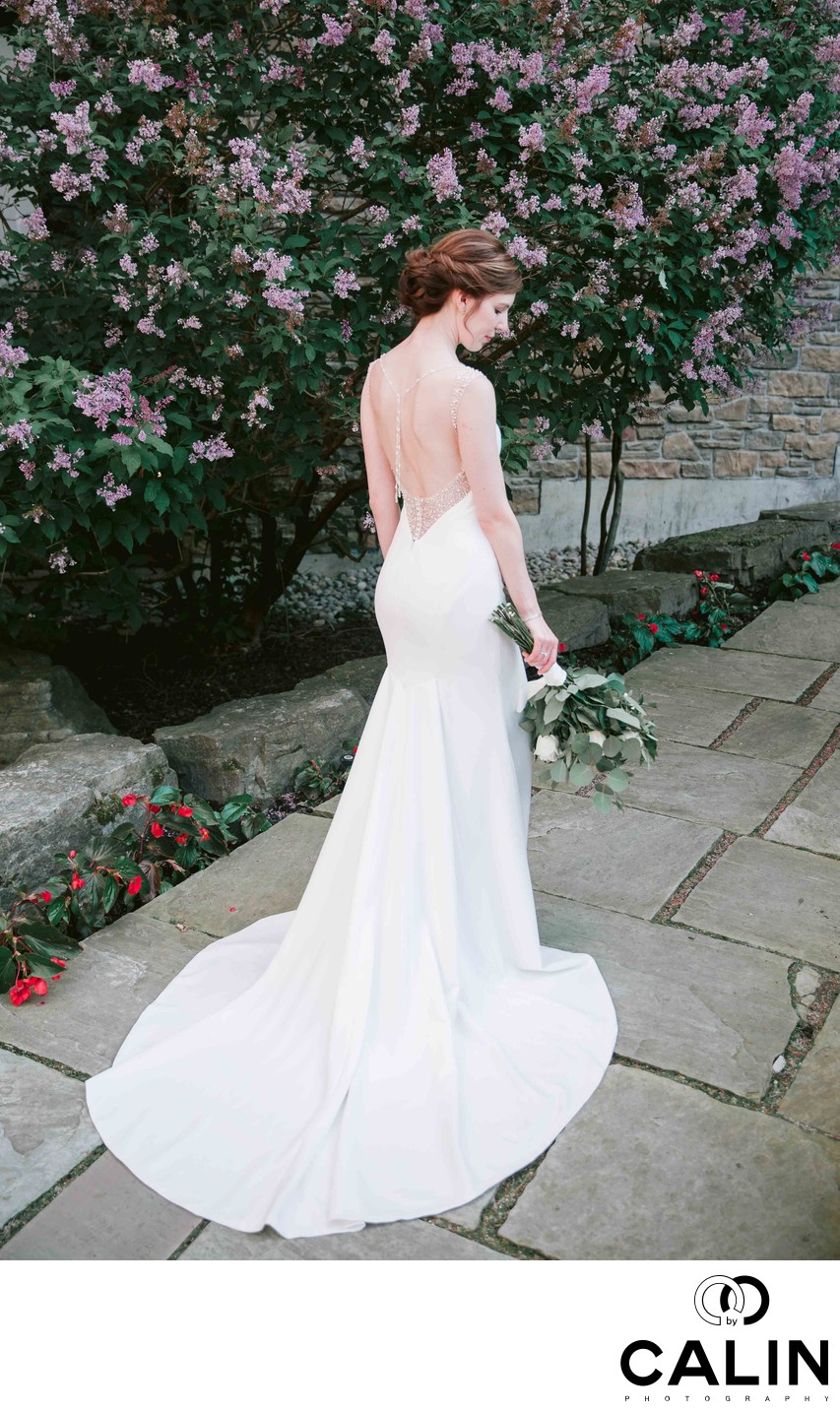
In this image, I photographed the bride from behind as she turns her head back toward me—an over-the-shoulder glance that feels private, like I’ve been allowed into her inner world for half a second. Her gown is fitted through the bodice and hips, then releases into a long, clean train that pours onto the stone walkway. The back of the dress is where the design does its talking: an illusion panel with beaded detail that catches light without shouting for attention. In her hand, she’s holding a bouquet of white roses and greenery—simple and classic, and the perfect counterpoint to the texture of the dress.
The setting does what the Old Mill does best: it gives me texture and history without stealing the scene. The stonework reads as timeless, and the lilac bushes in bloom soften everything with color and a natural, romantic edge. That mix—heritage stone and garden softness—is exactly why I love photographing an Old Mill Toronto Wedding in portrait time. This location gives me contrast without chaos. The bride stays the subject; the environment supports her.
The Context: How I Directed This Moment (Without Over-Directing)
I created this portrait right after a busier stretch of wedding-day coverage, when the energy is usually high and everyone is moving fast. I stepped the bride into a clean patch of walkway beside the lilacs and asked for two things only: a gentle weight shift (to elongate her posture and relax the hips) and a slow head turn back toward me. I’m not looking for a big “pose.” I’m looking for body language that reads like her.
I also chose this angle because it lets the dress tell the story. In wedding photography, the gown is one of the few elements that’s been planned for months, altered for precision, and emotionally loaded the second it’s worn. Photographing it with intention is part of respecting the day. Here, the long train becomes a leading line that brings your eye up toward her shoulder and face—exactly where I want you to land.
Gear & Lens Choice: Canon R5 + Canon RF L-Series Glass
I photographed this on my Canon R5, and I leaned on my Canon RF L-series lens to give me the combination I want for portraits at the Old Mill: crisp detail where it matters, gentle falloff where it doesn’t, and color that stays faithful in greens and florals.
Based on the perspective and compression, this is the kind of frame I typically make in the short-telephoto range—something that lets me keep the bride proportionate and elegant while still bringing the background close enough to feel immersive. I want the lilacs to read as a presence, not as clutter. The lens choice supports that: it narrows the scene, simplifies the edges, and keeps attention on her posture, her dress texture, and that turn of her head.
Lighting & Exposure Decisions: Soft Natural Light, Controlled Highlights
The light here is natural and even, which is exactly what I want for bridal portraiture. I’m not chasing dramatic flash effects in a moment like this—I’m chasing flattering tonality and a clean transition from highlights to shadows. The dress is white, the pathway is reflective stone, and the lilacs are bright; that’s three chances to blow highlights if I get careless.
So I exposed with the dress in mind first, protecting the brightest parts of the fabric while still keeping the bride’s skin tones soft and dimensional. The beadwork on the illusion back is a key detail: it needs enough highlight to sparkle, but not so much that it turns into harsh specular dots. This is where careful metering and a calm shooting pace matter. I’m not machine-gunning frames—I’m timing micro-movements and making sure every exposure is printable.
Composition & Depth of Field: Why the Frame Feels Clean
Compositionally, I built this photo on three layers: the stone path in the foreground (a subtle leading line), the bride as the subject, and the lilacs/stonework as a soft environment layer behind her. I kept the framing wide enough to respect the train—because the train is part of the portrait—while still making her head turn the emotional anchor.
Depth of field is intentionally shallow. I want the background to be recognizable but not competitive. The lilacs blur into color and texture rather than turning into botanical distractions. At the same time, the focus plane holds on the bride—especially the dress detail and the line of her shoulder—so the viewer feels the craftsmanship of the gown and the intimacy of the moment.
My Professional Critique: Why This Is a Great Wedding Photograph
This is a great wedding photograph because it succeeds emotionally and technically at the same time—without either one feeling forced.
Emotionally, the image reads as restrained confidence. The bride isn’t performing for the camera; she’s acknowledging it. That difference is everything. The over-the-shoulder glance creates connection without breaking the sense that she’s in her own world. It’s elegant, but it’s also human.
Technically, the frame is strong because it’s controlled. The highlights on the dress are held. The background is softened but still descriptive. The composition is deliberate: the train is used as a design element, not an afterthought, and the environment adds romance without stealing the subject. There’s also a subtle color harmony—greens, lilac tones, neutral stone, and white fabric—that feels natural rather than heavily stylized. The image looks refined because the decisions behind it were refined.
Post-Processing: Exactly How I Finished This Old Mill Toronto Wedding Look
My post-processing approach here is about realism with polish. I want the bride to look like herself on her best day, and I want the Old Mill environment to feel true to what it looked like while still carrying my signature finish.
First, I corrected the overall exposure and white balance to keep the dress neutral (not blue, not yellow) while maintaining natural skin tones. Then I shaped contrast gently—more of an S-curve with restraint—so the image keeps a soft roll-off in highlights while still holding definition in the gown’s beadwork and seams.
Next, I refined color. Greens can easily go neon, and lilacs can shift magenta fast, so I balanced the foliage and florals to stay believable. I reduced any distracting saturation while preserving the sense of bloom and season. After that, I used localized adjustments: subtle dodging on the bride to lift attention toward her face and upper body, and slight burning along the edges to keep the viewer’s eye inside the frame.
Finally, I finished with careful sharpening and noise control—sharpening targeted to detail areas (dress texture, beadwork), and noise reduction applied conservatively so the image retains a natural photographic surface. If there were any small distractions in the background (tiny bright spots or uneven patches), I would clean them with minimal retouching so the scene still feels authentic and not “over-edited.”
How I Build Variety at the Old Mill: From Solo Portraits to Storytelling Frames
A full Old Mill Toronto Wedding gallery needs range: solo bridal portraits like this, bridal party moments that show energy and connection, and romantic portraits that shift the focus from styling to relationship. I always shoot those categories with different pacing and different emotional targets, but I keep the visual language consistent so the final collection feels cohesive.