
Old Mill Toronto Wedding | The Quiet Moment I Always Chase
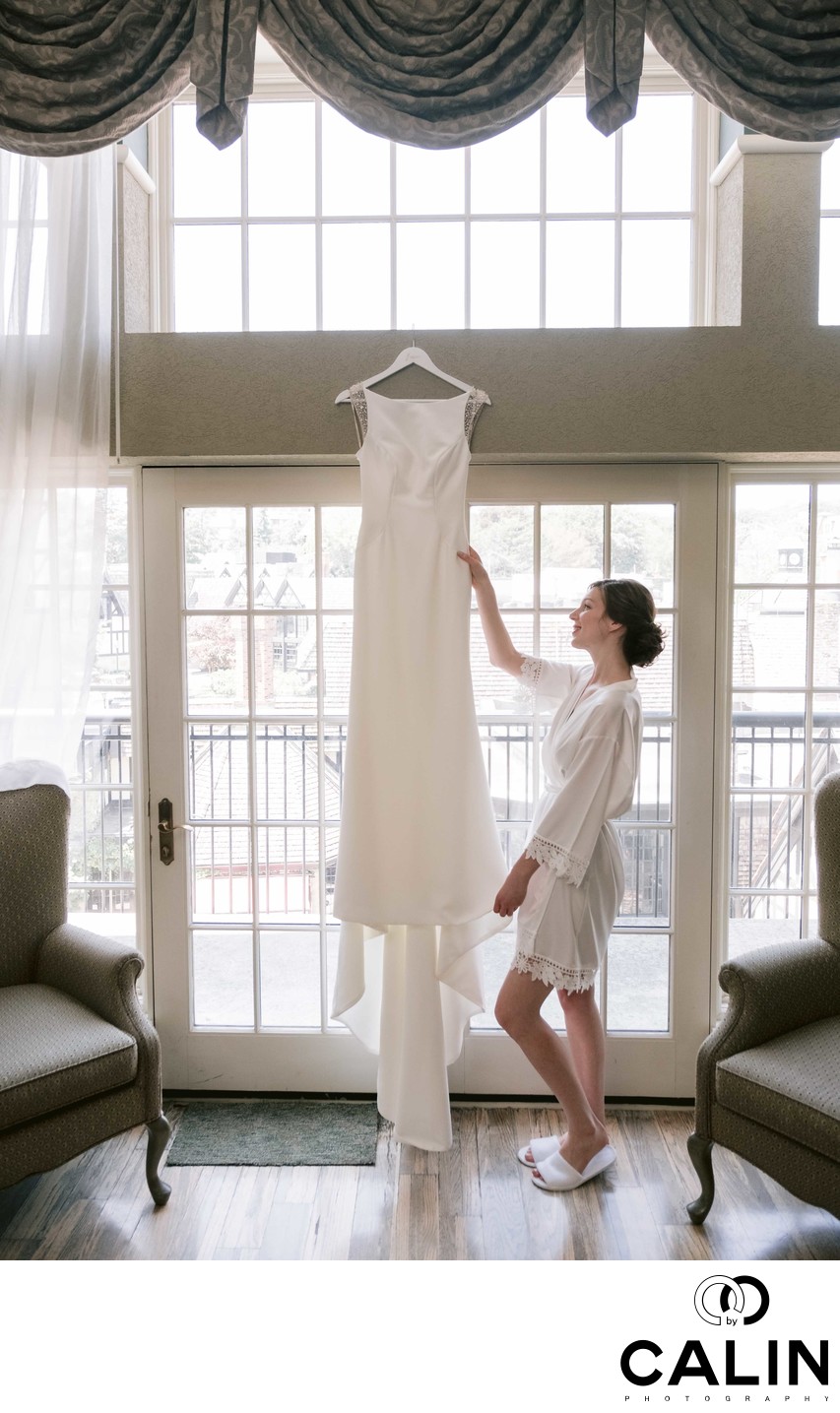
There’s a point in every Old Mill Toronto Wedding day when the noise drops away—no timelines, no chatter in the hallway, no music bleeding through walls—just the soft rustle of fabric and one deep breath before everything begins. This photograph lives in that pocket of silence. It’s the kind of frame I build entire wedding stories around, because it holds what couples rarely get to see: the exact second a day turns from preparation into memory.
How I Made This Frame (and Why I Waited for It)
I was already in the room, moving lightly, letting the space settle. At an Old Mill Toronto Wedding, the getting-ready rooms have a particular character—warm interior light, classic architecture, and a calm that feels curated even when the day is moving fast. I don’t force moments in here. I watch for them.
She stepped toward the gown with intention, not rushing. Instead of immediately “posing” her, I gave her a simple invitation: take a moment to arrange the dress the way you want to see it. That was it. No choreography. No over-direction. Just permission to be present.
That’s when the image happened—hands working carefully, the dress responding like silk and air, and her posture shifting into something unmistakably bridal: composed, focused, a little protective of the day ahead. The result is a photograph that feels lived-in, not manufactured.
If you’re planning your own Old Mill day and want to see the broader story from this venue, I’ve curated the full gallery here: Old Mill Toronto Wedding.
What You’re Seeing in the Photograph (A Photographer’s Reading)
The first thing I notice is the gesture. It’s not “bridal” in a performative way—it’s practical. She’s arranging the gown like someone who respects it. The dress becomes more than a garment; it becomes the physical symbol of what the day represents.
The room is doing quiet work in the background: soft, warm illumination; gentle contrast; and a sense of privacy that keeps the image intimate. I’m always looking for backgrounds that support the story without stealing it. In this frame, the environment stays in its lane—present, but not loud.
Compositionally, I’m using the dress as a leading element. The fabric creates flow through the frame and gives the image its movement. Your eye lands on her hands, then travels through the folds, then returns to her—like a visual loop that keeps you inside the moment.
For more of the refined, tactile elements from this morning—textures, details, and the little design decisions that make an Old Mill day feel elevated—see: bride’s details at Old Mill Toronto.
Gear & Lens Choice: Why Canon R5 + RF Mount Canon L Glass Matters Here
I photographed this on a Canon R5 with an RF mount Canon L-series lens. For these quiet indoor scenes, I prioritize two things: reliable autofocus in soft light and the kind of rendering that keeps highlights gentle on white fabric.
Lens-wise, this frame calls for an L lens that can separate subject from background without turning the scene into mush. In practice, I’m typically choosing something in the RF 50mm f/1.2L or RF 85mm f/1.2L territory for this look—premium contrast, clean color, and a depth of field that feels intentional rather than accidental. The goal isn’t “blurry background” as a gimmick; it’s emotional focus. (Exact focal length and settings can vary by distance and room layout, but the visual signature is consistent with a fast prime.)
Techniques at Work: Light, Composition, and Depth
Lighting: I’m using available light first, shaping it with my position rather than adding flash. In a room like this, the key is avoiding harsh specular highlights on the gown. I angle myself so the brightest area skims across the fabric instead of punching straight into it. That keeps whites detailed and dimensional.
Exposure discipline: Wedding dresses punish sloppy exposure. I protect highlights while still lifting shadow detail enough to preserve the room’s atmosphere. On the Canon R5, that means trusting the sensor’s latitude but not abusing it. I’d rather get it right in-camera than “rescue” it later.
Composition: I build structure with the dress lines. I’m looking for curves that lead and edges that frame. I keep the background simplified and I watch for distractions at the borders—door frames, bright lamps, stray objects. The clean perimeter is part of why this feels polished.
Depth of field: I’m shooting wide enough to isolate, but not so wide that the story falls apart. I want her hands and the critical fabric detail sharp, while the rest falls away gradually. That transition is what makes the image feel cinematic instead of “thin.”
Why This Is a Great Wedding Photograph (Unequivocal Critique)
This is a great wedding photograph because it delivers emotional clarity and technical precision at the same time.
Emotionally: it’s honest. The bride isn’t performing for the camera. She’s doing something real, and that authenticity hits harder than any forced smile. You can feel anticipation without needing to see a face in close-up. The hands, the posture, the care—those are the tells. This is the kind of image couples return to years later because it reminds them how it felt, not just how it looked.
Technically: the whites are controlled, the tones are warm without going orange, and the focus placement is purposeful. The dress retains texture. The background stays supportive. The frame reads quickly—subject first, story second, environment third—which is exactly the hierarchy I want in a wedding image.
Artistically: it has movement. The dress isn’t static; it’s flowing, and that flow is the visual metaphor for the day about to unfold. This is not a random “getting ready” shot. It’s a transition scene, and it works because everything inside the frame reinforces that idea.
Post-Processing: How I Finished the Image (Detailed Workflow)
I process this kind of photograph with restraint and intention. The goal is to preserve the natural mood of an Old Mill Toronto Wedding morning while refining the image into something clean, cohesive, and timeless.
1) Color management and baseline correction: I start by neutralizing any mixed-light color shifts. Indoor tungsten warmth can be beautiful, but it can also contaminate whites. I dial white balance to keep skin tones believable and the gown truly white (not cyan, not yellow). I fine-tune tint to prevent green/magenta drift in the shadows.
2) Highlight control (dress protection): I selectively pull back highlights and whites to recover lace and fabric texture. Then I reintroduce controlled brightness with a gentle tone curve so the image still feels luminous, not flat. I avoid “crunchy” micro-contrast on the dress; it makes fabric look brittle.
3) Local dodging and burning: This is where the photograph becomes dimensional. I dodge along the areas of fabric that should catch light and burn slightly in the folds to emphasize flow. I also guide attention subtly toward the hands and the most important part of the dress arrangement. The effect is invisible when done right—viewers just feel the image is sculpted.
4) Color grading (warmth with control): I keep the palette warm and romantic but protect neutrals. That means warming midtones while keeping whites clean and shadows stable. I’ll often desaturate certain warm channels slightly so the room feels elegant rather than overly amber.
5) Cleanup and polish: I remove minor distractions—small bright points, stray lint on fabric, anything that pulls the eye away from the story. I do it conservatively; the image should still feel real.
6) Sharpening and grain: I apply sharpening with masking so it targets edges that matter (hands, lace detail) without roughing up smooth areas. If the scene benefits from it, I add a fine, consistent grain to unify tones and keep the image from looking digitally slick.
Where This Moment Leads Next
After she finished arranging the gown, the room felt even quieter—like the air itself was waiting. A letter appeared, folded carefully, held with the same respect she gave the dress. When she began reading, her shoulders softened. That’s the emotional bridge I always look for: preparation turning into meaning.
If you want to follow that sequence in the story, view: bride reads groom’s letter at Old Mill Toronto.