
Old Mill Toronto Wedding: The Ceremony Portrait I Waited All Day For
I’ve photographed enough weddings to know that the most powerful frames rarely come from perfect poses—they come from a few quiet seconds when everyone forgets about the camera. This ceremony portrait at an Old Mill Toronto Wedding is one of those frames: clean, emotional, architectural, and honest, all at once.
What You’re Really Seeing in This Ceremony Portrait
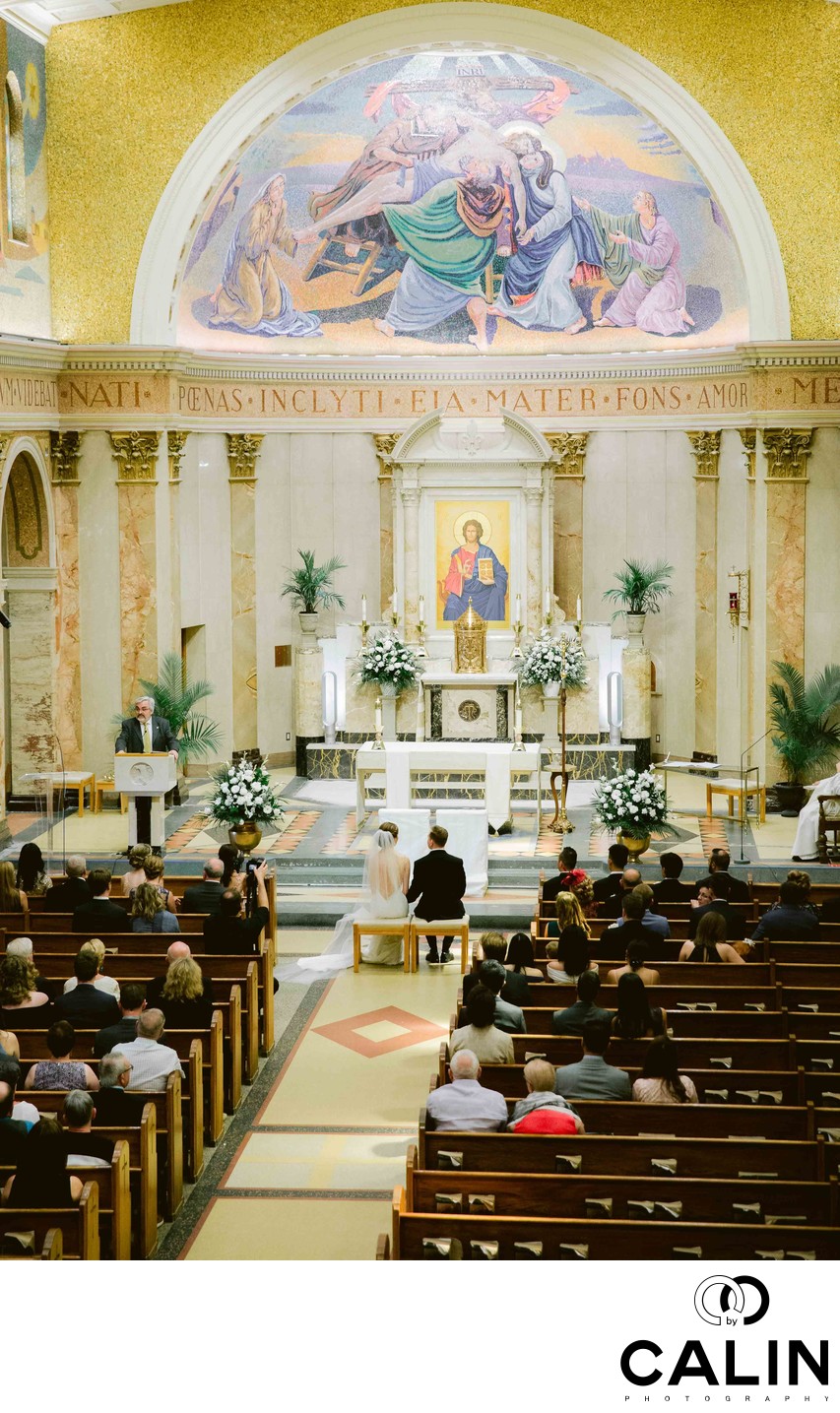
When I made this image, I wasn’t chasing a trendy angle. I was chasing clarity—clarity of story, clarity of light, and clarity of design. From an elevated vantage point, the couple becomes the center point of an intentional, symmetrical scene. The room’s defining features—arched ceiling lines, repeating windows, and warm, airy tones—act like leading lines that pull your eye directly to them. It’s the kind of composition where the venue’s character doesn’t compete with the couple; it frames them.
I remember scanning the space before guests fully settled in, looking for a perspective that would show the ceremony as it felt: intimate, bright, and calm. There’s a simplicity here that I love—no chaotic background, no clutter—just the couple in their moment, wrapped by the architecture of the Old Mill’s ceremony space. As described on the page itself, my goal was a “bird’s eye view of the ceremony,” using a dramatic, elevated angle to reveal the venue details in a natural way. Old Mill wedding aisle moments matter, but this overhead portrait is where the day’s geometry finally locks into place. [Source](https://www.bycalin.com/weddings/albums/old-mill-toronto-wedding/bride-groom-portrait-ceremony)
The Context: How This Frame Happened (And Why Timing Matters)
This was taken during the ceremony, in that window when emotion is high but movement slows. I knew I wanted an elevated view, so I planned for it—quietly. I watched for a moment when the couple settled into stillness and the surrounding guests naturally formed a balanced frame around them. According to the page notes, the groom is placed next to the bride, smiling and looking at her, while close family sits in the front row. Those small relationship cues are the story: who leans in, who watches, who holds still, who can’t stop smiling. [Source](https://www.bycalin.com/weddings/albums/old-mill-toronto-wedding/bride-groom-portrait-ceremony)
I also waited for the light to do what it naturally wanted to do. The room has many windows, and sunlight streams in from multiple directions. That matters because it creates layered illumination—soft, dimensional, and forgiving. Add the candlelight mentioned on the page and you get a gentle warmth that feels human rather than clinical. The atmosphere reads romantic without me having to “manufacture” it. [Source](https://www.bycalin.com/weddings/albums/old-mill-toronto-wedding/bride-groom-portrait-ceremony)
Gear and Lens Choice: Canon R5 + Canon RF L-Series
I shot this wedding on a Canon R5—my workhorse for fast-paced, high-emotion days—paired with a Canon RF mount L-series lens. For an overhead ceremony portrait like this, I reach for an RF L lens that gives me two things: (1) edge-to-edge consistency so the architecture stays crisp and believable, and (2) the right focal length to keep faces readable while still honoring the space. I’m always balancing people and architecture at an Old Mill Toronto Wedding, because the venue has such a distinct visual identity.
I’m intentionally not treating this as a “wide shot for the sake of wide.” A great ceremony portrait is about proportions: how much room you show, where the couple sits in that room, and whether the viewer can understand the emotional hierarchy of the scene in one glance.
Photographic Techniques: Composition, Light, and Depth Control
The core technique here is architectural composition applied to wedding storytelling. I used an elevated angle to align the ceiling arches and window rhythm so they feel purposeful rather than accidental. The symmetry gives the frame stability—exactly what you want when the couple is experiencing something huge internally. A stable frame lets the emotion breathe.
Lighting-wise, I leaned into the existing conditions. The page notes emphasize natural light and warm, bright tones, and that’s exactly what I built around. I exposed to protect highlights from the windows while keeping skin tones soft and luminous. The candlelight adds micro-contrast—tiny warm points that keep the scene from feeling flat.
Depth of field choices for this kind of image are strategic. I don’t want extreme blur because the room is part of the story. Instead, I aim for a depth that keeps the couple and immediate context clear, while letting distant details gently simplify. It’s not about “bokeh”; it’s about readability.
Why This Is a Great Wedding Photograph (Unequivocally)
This is a great wedding photograph because it delivers three difficult things at once: emotion, place, and order.
Emotion: The groom’s expression—smiling and looking at the bride—anchors the entire image. Even at a distance, that directional gaze tells you exactly what matters. It’s a small human detail that prevents the frame from becoming “just a venue shot.”
Place: The Old Mill’s arched ceiling and window light are not generic. They’re specific, recognizable, and they carry mood. The setting reads warm and cinematic without being forced, exactly as described: bright, warm colors, sunlight streaming in, candles adding a subtle glow.
Order: The lack of background distractions is a victory. The page notes there are no people in the background, which is rare during a ceremony and incredibly valuable for visual impact. That clean backdrop lets the architecture act as negative space, keeping the composition bold instead of busy. Put simply: the frame is intentional. It looks like it was designed, but it still feels real. That combination is what separates a strong wedding image from a forgettable one.
Post-Processing: How I Finished the Image (In Detail)
My edit philosophy for an Old Mill Toronto Wedding is to preserve what the room already gives you: warmth, softness, and romance—without turning the image into a filter. For this photograph, my processing is typically built on five pillars:
- Exposure shaping: I fine-tune overall exposure, then use localized adjustments to keep window highlights controlled while lifting midtones around the couple so they remain the visual priority.
- White balance discipline: Mixed light is common here—daylight from windows, warm interior ambience, and candlelight. I balance to keep skin tones natural while allowing the room’s warmth to remain believable.
- Color grading for cohesion: I gently harmonize yellows and oranges so the warmth reads elegant, not heavy. I keep neutrals clean so the whites don’t drift muddy, especially in architectural interiors.
- Micro-contrast control: I add subtle texture to architectural lines (arches, trim, window frames) while keeping faces smooth and flattering. This is about selective clarity—not global “crunch.”
- Perspective and crop refinement: Elevated angles can exaggerate geometry. I correct verticals and refine framing so the symmetry feels stable. If the composition is off by even a few pixels, the image loses authority.
The goal is a finished photograph that still feels like the room on that day: bright, warm, and calm—where candlelight looks like candlelight and sunlight looks like sunlight.
How This Image Connects to the Peak Moment
I always think in sequences. This overhead ceremony portrait is the “chapter title” image—the one that establishes setting and stakes before the emotional payoff. And when the couple finally leans into that once-in-a-lifetime second, the story completes itself with the moment everyone waits for: Old Mill Toronto first kiss.