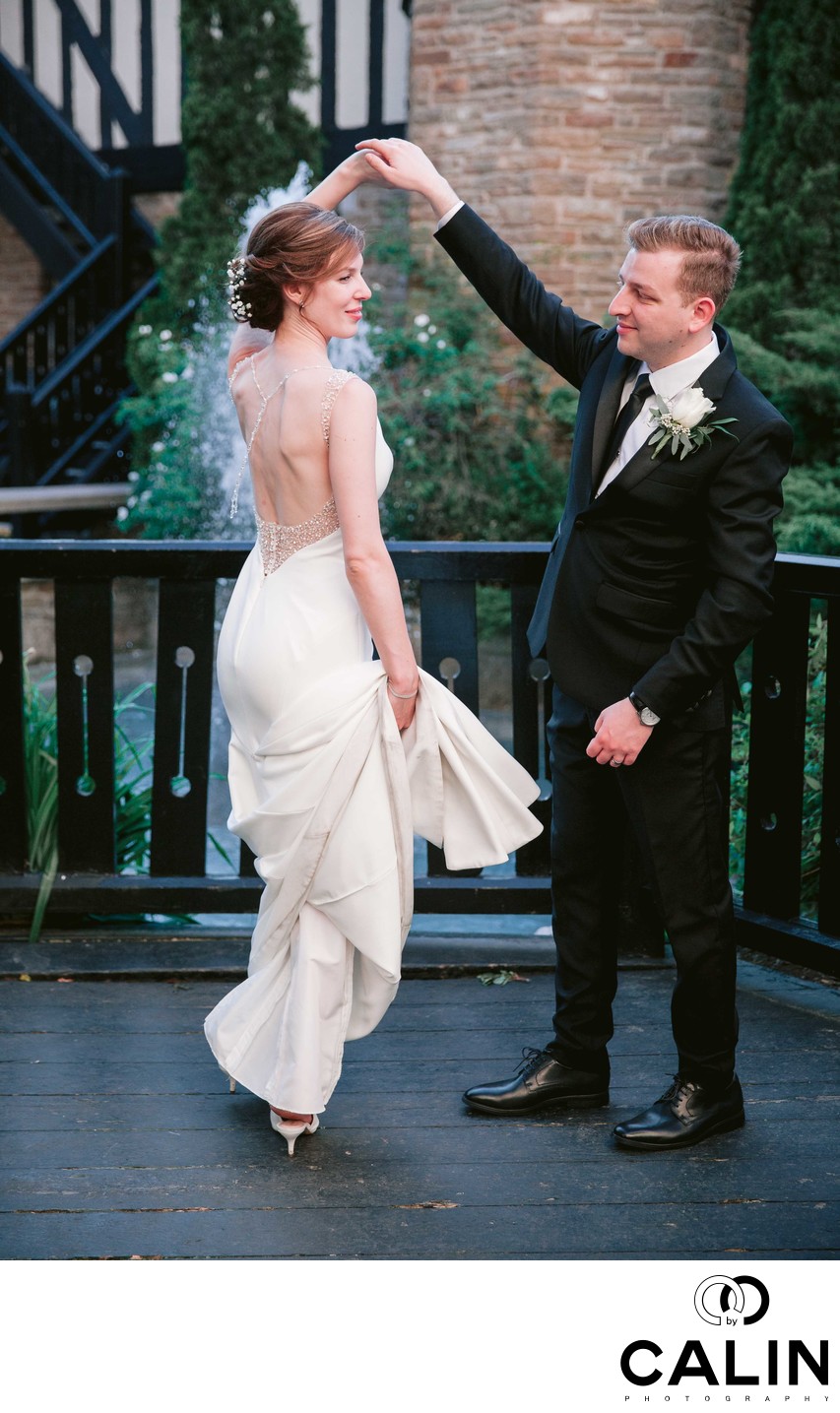

Old Mill Toronto Wedding: The Twirl That Told the Whole Story
I’ve photographed a lot of weddings in Toronto, but there’s a specific kind of energy that shows up at the Old Mill—equal parts historic romance and relaxed, real-life warmth. This moment, the bride mid-twirl while her partner anchors her with a steady hand, is the kind of frame that looks effortless but is built on dozens of small decisions I make in seconds: where I stand, what I exclude, how I time the movement, and how I shape the light.
What Was Happening Right Before This Frame
We were outside, in that classic Old Mill pocket where greenery wraps around the space and the architecture quietly reminds you you’re somewhere special. The couple had just finished a few still portraits—those calm, symmetrical images that every album needs—when I felt their nerves dissolve. The groom made a small joke, the bride’s shoulders dropped, and the mood shifted from “we’re being photographed” to “we’re together.”
I gave them one direction only: “Hold hands and do one spin like you’re celebrating.” No choreography, no overexplaining. The bride stepped into the twirl with a confident, playful snap, and her dress responded like it had been waiting all day for that exact move. The groom leaned in—protective but not stiff—and the smile on her face wasn’t posed. It was the release you feel when the day finally becomes yours.
The Scene & What You Can Actually See
In the photograph, the groom is in a classic black tuxedo with a crisp white shirt and boutonnière, and the bride is in a white gown with a lace back and a full skirt that fans outward as she spins. They’re on a wooden deck with lush greenery behind them, and you can catch hints of Old Mill character in the background—brickwork, tidy shrubs, and that storybook, Tudor-style feel that makes this venue so recognizable.
The way the environment sits behind them matters: it’s present, but it doesn’t compete. The background supports the couple instead of stealing attention, which is exactly what I want in a signature Old Mill Toronto wedding portrait—place and emotion in the same sentence, without either one shouting.
How I Shot It (Cameras, Lens Choice, and Why)
I shot this using Canon R5 cameras and Canon RF-mount L-series glass. For a moment like a twirl, I want two things at once: clean subject separation and a perspective that still feels intimate. That’s why I reach for an RF L lens that gives me a flattering compression without flattening the scene into a backdrop. The result is that the couple stays dominant in the frame while the Old Mill setting remains readable and elegant.
Practically, this approach also keeps me out of their personal space. If I crowd them with a wide lens, the spin becomes self-conscious and the body language tightens. With this focal length range, I can direct lightly, shoot continuously through the movement, and let them forget about me—while still capturing the texture of the lace, the crisp edges of the tux, and the motion in the skirt.
Technique: Timing, Composition, and Light
The heartbeat of this image is timing. A twirl has a “messy middle” where faces turn away, arms look awkward, and the dress collapses instead of blooming. I’m waiting for the split second where her rotation opens the gown into a clean shape, where their hands connect without tension, and where her expression lands toward camera just enough to read as joy.
Compositionally, I’m balancing motion with stability. The groom becomes the visual anchor—upright, darker, structured—while the bride becomes the movement—light, flowing, expanding. That contrast is why the frame reads quickly and emotionally. The deck lines add subtle structure underfoot, and the greenery gives a soft, romantic border behind them without turning the background into noise.
The light here is soft, natural, and flattering—more wrap than punch. I’m using it to reveal detail (lace texture, fabric folds) while keeping skin tones gentle. With weddings, I’d rather shape light through positioning and angle than force drama that doesn’t belong to the moment. This is celebration, not a fashion editorial.
Why This Is a Great Wedding Photograph (No Hedging)
This is a great wedding photograph because it captures a real emotional peak while still being technically controlled. The bride’s smile isn’t a “camera smile.” It’s a smile aimed at the person who just promised her a lifetime. The groom’s posture reads as confident and present, not performative. The hand connection is clear. The motion is readable. Nothing feels accidental.
Technically, the image succeeds because the subject separation is intentional, the exposure holds detail in the dress without turning it into a blown-out white shape, and the background stays complementary. The frame is clean—no distracting clutter, no competing faces, no random objects cutting through bodies. You feel the energy of the twirl, but you also feel the calm competence behind the camera that kept the image coherent.
Most importantly, it tells a complete story in one glance: “We made it. We’re happy. We’re having fun.” That’s the entire point of an Old Mill Toronto wedding—classic atmosphere, real connection, and moments that don’t need explanation.
My Post-Processing: What I Did and Why It Matters
The edit on an image like this is about preserving truth while polishing distractions. My first step is a clean, neutral base: correct white balance so the dress stays white (not blue, not yellow), then set exposure to protect highlights in the gown while keeping the groom’s tux from turning into a featureless black block.
Next, I shape contrast locally, not globally. I’ll add gentle micro-contrast to lace and fabric folds so the dress has dimension, then smooth contrast in the background so foliage doesn’t compete with faces. I also refine color with restraint: greens should feel natural, not radioactive; skin tones should look alive, not orange. If there’s any mixed light, I’ll correct it selectively so the couple matches, rather than letting one face go warm and the other go cool.
Then comes subtle dodge and burn—targeted, not heavy-handed. I lift the faces slightly to pull your eye exactly where the emotion is, and I deepen a few shadows around the edges of the frame to keep attention centered. Finally, I check the small things: stray bright spots in the background, tiny distractions on the deck, and consistency in the whites so the gown looks luxurious instead of flat.
The goal is simple: the couple should look like the best version of themselves in the best moment of their day, without the image looking “worked on.”
How This Moment Fits Into the Full Wedding Story
I think of this twirl as the turning point in the portrait session—the second the couple stops “doing photos” and starts living the day again. When I build a gallery, I want that emotional arc: anticipation, connection, release, celebration. This frame sits right at the release.
A few minutes later, we moved into closer, quieter frames—foreheads near, hands lingering, the kind of contact that reads like a promise. Those images belong naturally alongside moments like bride and groom hugs and kisses at Old Mill Toronto, because affection looks different when it’s earned by the day’s momentum.
And once portraits are done, the story always expands—more voices, more movement, more light sources, more unpredictability. The day transitions into the next chapter at the venue, and it’s why I love photographing the celebration that follows, like the Old Mill Toronto wedding reception, where elegance meets the kind of joy you can’t stage.