
Old Mill Toronto Wedding: The Walk Down the Aisle I’ll Never Forget
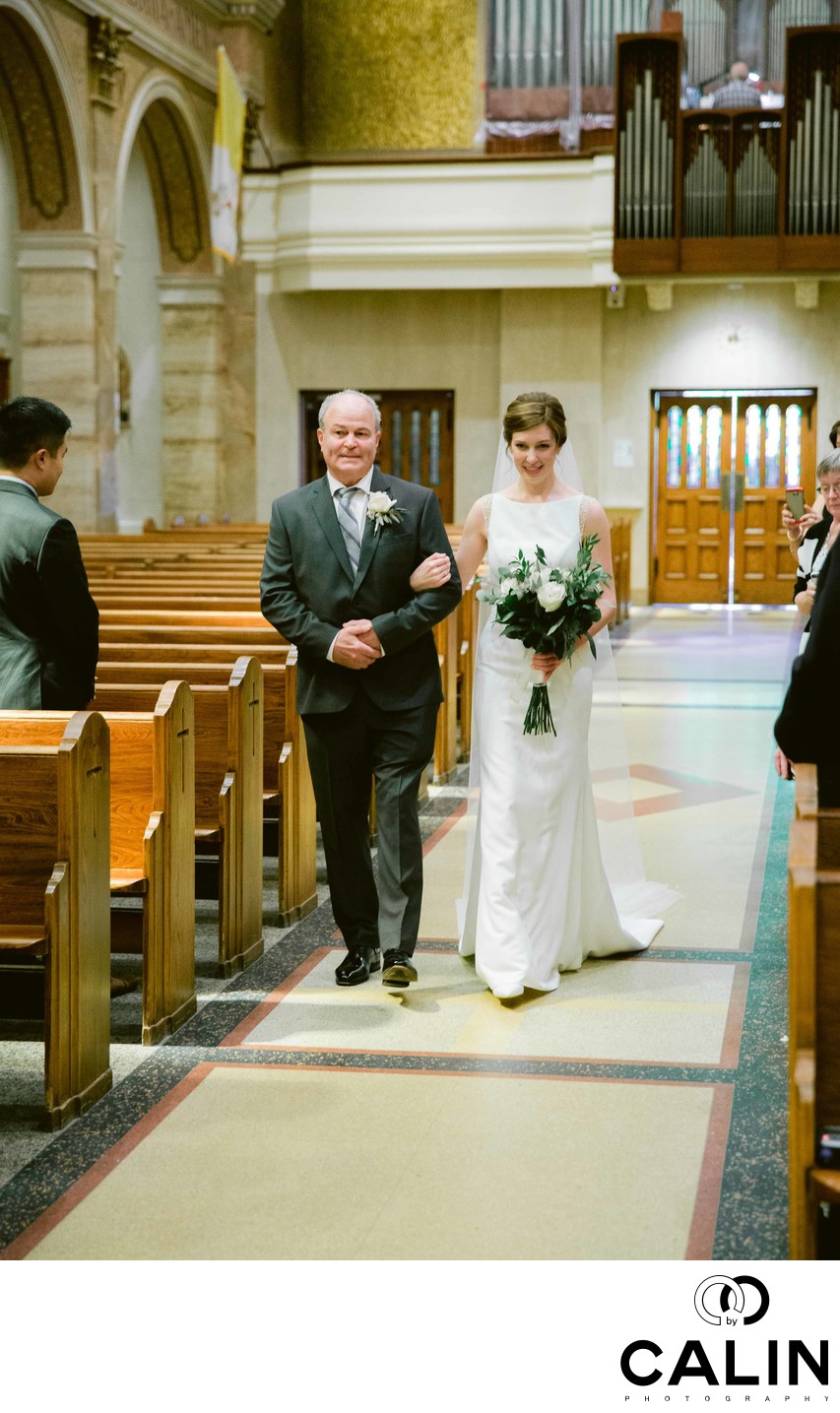
I’ve photographed a lot of ceremonies over the years, but there are a few moments that still hit me in the chest the same way they did the first time I witnessed them through a viewfinder. This was one of those moments: the bride stepping into the aisle, bouquet held steady, shoulders squared, and that unmistakable mix of nerves and certainty in her expression as she moved toward the person waiting for her.
The Second the Doors Opened (and Everything Got Quiet)
The aisle at the Old Mill has a particular feeling to it—historic, intimate, and structured in a way that naturally focuses everyone’s attention forward. When I saw her enter, I knew I had to photograph this in a way that felt like being there: not just documenting what happened, but preserving the pressure of the moment. I watched her take that first step, and I could see the room recalibrate around her—guests leaning in, hands tightening around programs, a few people already dabbing at their eyes.
I’m always listening during a processional: the pace of footsteps, the subtle pauses, the small breaths. Those cues tell me how to time the frames. This bride didn’t rush. She moved with intention. The person walking beside her stayed half a step back—close enough to be supportive, far enough to let the moment be hers. That kind of body language is pure story, and it’s exactly what I’m looking for.
What You’re Really Seeing in This Photograph
This image works because it holds two stories at once: the bride’s forward motion and the stillness of everyone watching. The architecture and the aisle act like a visual funnel, directing your eye straight to her. The wooden pews create repeating lines, the pipe organ and stained glass add context and gravity, and the ceremony space frames the couple’s entrance like a stage—but without feeling theatrical. The room feels lived-in and real, not like a set.
Emotionally, it’s not “big” in an exaggerated way. It’s controlled, contained, and therefore more believable. Her grip on the bouquet is calm. Her posture is upright. Her gaze is forward. It reads as confidence built on something deeper than adrenaline—like she’s already decided, long before this walk, that she’s exactly where she should be.
How I Shot It: Camera, Lens, and Why the Choice Matters
I photographed this using Canon R5 cameras and Canon RF-mount L-series lenses. For a walk down the aisle like this, I want compression that flatters, isolates, and simplifies—without turning the background into meaningless blur. In a ceremony space with this much character, the background is part of the story, so I’m balancing separation with context.
If I had to explain the “why” in one sentence: I needed a lens that could give me crisp facial detail, clean subject separation, and reliable autofocus under mixed interior light—without forcing me to use flash and disrupt the ceremony.
I also shot this with a wide aperture to create a shallow depth of field: the bride and her escort are tack sharp, and the environment falls off gently. That falloff matters. It creates visual priority while still letting you recognize the setting as an Old Mill Toronto Wedding ceremony space.
Lighting, Composition, and Timing: The Technique Behind the Feeling
The light here is soft and directional, likely coming from the church windows and ambient interior lighting. What I like about it is that it doesn’t carve harsh shadows into faces. Instead, it wraps—giving skin a natural texture and keeping the mood quiet and respectful. That’s ideal for a processional. I’m not trying to make it look like a fashion shoot; I’m trying to make it look like truth, at its best.
Compositionally, I leaned into leading lines. The aisle guides the eye. The pews repeat like brackets. The organ pipes and architectural symmetry add stability, which contrasts nicely with the movement of the bride walking forward. There’s also a subtle sense of depth: foreground lines pull you in, midground holds the subjects, background completes the location.
Timing-wise, this is about anticipating the micro-moments: the half-step, the slight turn of the shoulders, the way the bouquet lifts and settles with each breath. There’s no visible motion blur, which tells you I kept shutter speed high enough to freeze movement while still preserving the softness of ambient light.
My Straight Critique: Why This Is a Great Wedding Photograph
This is a great wedding photograph because it has emotional clarity and technical discipline at the same time. The emotion is readable even without seeing anyone else’s face clearly—because the posture, spacing, and direction of movement tell the story. It’s a photograph with a heartbeat, not a pose.
Technically, it succeeds because nothing is fighting for attention. Focus is where it needs to be. Exposure is controlled in a challenging indoor environment. The depth of field is shallow but not careless; the bride is separated from the background without deleting the venue’s identity. The colors feel consistent and believable—warm wood tones, neutral whites, and a gentle overall palette that matches the mood of the ceremony.
If I’m being picky (and I always am, even with my favorite frames), the only “risk” with a space this symmetrical is alignment. Symmetry is powerful, but it’s unforgiving—so I’m constantly checking that the aisle and vertical architectural lines sit where they should. In this frame, the geometry supports the subject instead of distracting from her, which is exactly the point.
Context Within the Day: The Moment Before the First Look of the Ceremony
The walk down the aisle is its own kind of first look—public, irreversible, and charged. The groom’s reaction is always a parallel story happening at the same time, even when he’s not in the frame. If you want to see how that emotional thread connects, this moment pairs beautifully with the groom seeing the bride at their Old Mill Toronto Wedding.
After the ceremony energy settles, I shift gears into portrait-making: slower pace, more breathing room, cleaner direction. That’s where the story turns from anticipation to relief. If you’re looking for that transition, it continues with their bride and groom portrait after the ceremony.
Post-Processing: What I Did (and Why) in Detailed Terms
My editing approach here is designed to protect what already works: natural light, real skin tone, and the warmth of the room. The goal is refinement, not reinvention. For this image, my post-processing workflow typically includes:
First, I correct exposure and tonal balance globally—lifting shadows slightly to keep detail in dark suits and wood pews, while controlling highlights in the dress so the whites stay textured rather than flat. I fine-tune white balance to keep the gown neutral and the environment warm, avoiding that unpleasant yellow-green cast that can creep into indoor ceremony lighting.
Next, I shape contrast locally. I use gentle dodging and burning to guide attention: a touch of lift on faces and hands, subtle darkening around the edges of the frame, and a controlled emphasis on the aisle as a leading path. This kind of micro-contrast work is what makes the photograph feel dimensional without looking “over-edited.”
Then I refine color: I keep saturation restrained and focus on consistency—wood tones stay rich but not orange, greens (if present in ambient reflections) stay natural, and whites remain clean. I also apply targeted HSL adjustments so skin tones remain realistic under mixed interior light, while the background stays supportive rather than loud.
After that comes detail work: selective sharpening on the subjects (especially eyes and facial features) while keeping background texture slightly softer so it doesn’t compete. I reduce noise carefully in shadow areas to preserve a clean look without smearing fine detail. Finally, I do a distraction sweep—tiny bright spots, minor color distractions, and anything pulling the eye away from the bride gets toned down.
The end result is a photograph that still feels like the room felt—only clearer, calmer, and more intentional. That’s what I want people to remember when they think back on their Old Mill Toronto Wedding ceremony: not just how it looked, but how it held them.