
Old Mill Toronto Wedding: Photographing the Exact Moment the Morning Becomes Real
I’ve photographed a lot of wedding mornings, but there’s a particular kind of quiet electricity that happens inside the Old Mill. The hallways feel historic without being heavy, and the hotel rooms have a softness that photographs beautifully when the day begins to unfold. This is one of those frames where everything I love about an Old Mill Toronto Wedding comes together: warm wood underfoot, clean window light, and a circle of people doing the small, essential work that turns anticipation into reality. Old Mill Toronto Wedding photography.
The Scene I Walked Into (and Why I Didn’t Interrupt It)
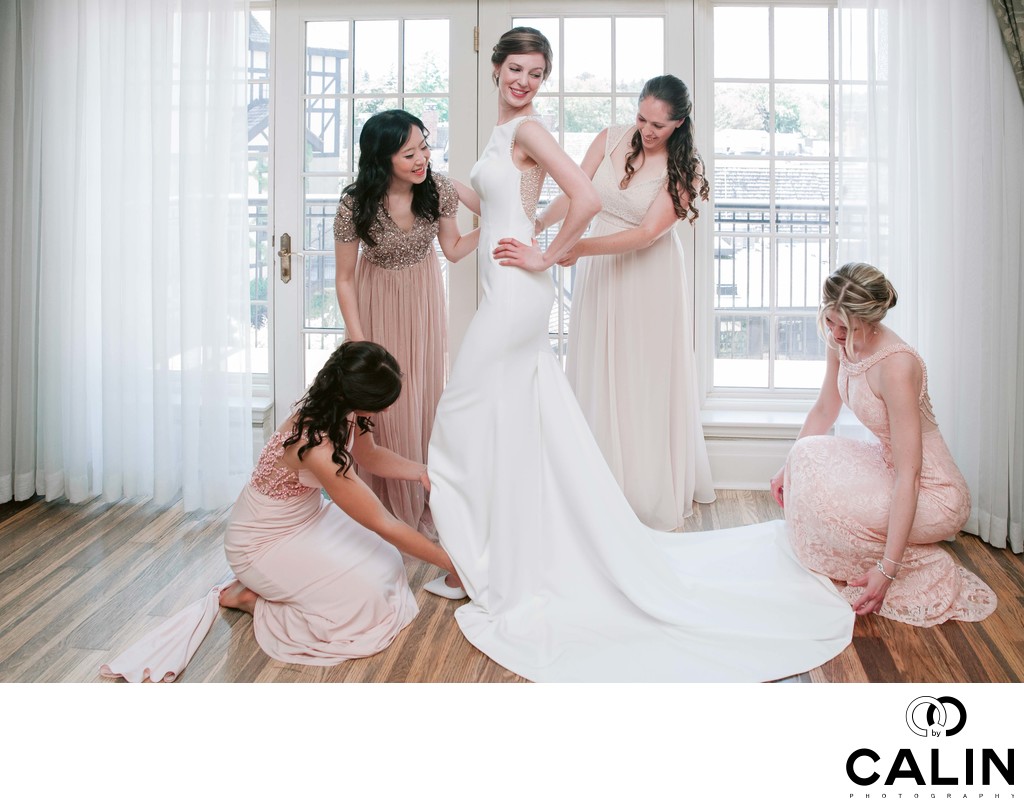
When I stepped into the room, the energy wasn’t loud—it was concentrated. The bride was centered in the frame before I ever raised my camera: upright, steady, already composed in that way people get when they’re moments away from a life-changing walk. Around her, four bridesmaids formed a loose half-circle, each focused on a different detail of the dress. Their pastel dresses created a gentle color harmony—blush and pale pink tones that read romantic without competing with the white gown. The floor was a warm wood that grounded the scene, and the large windows behind them delivered clean, flattering daylight that made the room feel open and honest. This wasn’t a “pose.” This was the real work of getting dressed, and it deserved to stay real. Old Mill Toronto Wedding album. Photo content notes: bride in a white gown with a long train, bridesmaids in pastel dresses, bright window light, warm wood floor, shallow depth of field.
My job in moments like this is to read the room faster than I shoot it. I’m watching hands: who’s adjusting fabric, who’s smoothing the train, who’s checking the back closure. I’m watching faces: the bride’s calm focus, the bridesmaids’ concentration, that brief flash of “we’ve got you” that passes between friends without anyone saying it out loud. The moment I saw the train spread across the floor and the bridesmaids naturally arranging it, I knew the story was already composed—I just had to photograph it without getting in the way.
How I Captured This Frame: Camera, Lens, and Decisions in the Moment
I photographed this on a Canon R5 using a Canon RF L-series lens—the kind of combination I rely on for wedding prep because it handles contrasty window light cleanly and gives me fast, accurate focus when people are moving in close quarters. For a scene like this, I’m typically choosing an RF L lens that lets me work quickly without distorting bodies at the edge of the frame, while still giving enough field of view to show the environment and the relationship between people.
My priority here was to keep the bride as the visual anchor while still honoring the bridesmaids as active characters, not background props. I placed the bride near center, allowing the train to lead your eye through the lower half of the image. The bridesmaids create a supportive arc around her—visually reinforcing the emotional reality of the moment. I let the windows do the heavy lifting: that soft daylight wraps faces and fabric without the harshness you’d get from overhead room lighting. Visual/lighting reference: bright window light behind subjects; shallow depth of field isolates the group.
Lighting, Composition, and Depth of Field: The Technical Backbone
The lighting is natural and directionally consistent: large windows provide broad, soft illumination. That matters because wedding dresses punish messy light—every fold becomes a distraction if the highlights clip or if shadows turn muddy. Here, the window light stays gentle and even, which keeps texture in the gown and preserves detail in the pastel bridesmaid dresses. I exposed to protect the whites first, then ensured skin tones stayed warm and believable.
Compositionally, the photograph works because it has a clear hierarchy. The bride’s white dress is the brightest, most attention-grabbing element; the bridesmaids’ colors support it; the wood floor adds warmth; and the background falls away just enough so the story stays on the people. I used shallow depth of field intentionally—not as a gimmick, but as a way to simplify the room and keep the viewer’s attention on hands, fabric, and expressions. This is a “moment” photograph, and the focus needs to feel emotional, not clinical.
The Story in the Room: What This Moment Means During an Old Mill Toronto Wedding
At an Old Mill Toronto Wedding, the morning often moves in a series of quiet chapters: dress, letters, family visits, the first time a parent sees their child fully ready. This particular moment sits right at the hinge between preparation and ceremony. When the bridesmaids started working together—one lifting the train, another smoothing a seam, another checking the fit—it wasn’t about perfection. It was about care. The bride wasn’t performing for anyone; she was being supported.
I remember how the room sounded: a few quick instructions, a soft laugh, then that hush people slip into when they realize the next step is irreversible—in the best way. If you’ve ever watched a bride take a breath as the last adjustments happen, you know it’s not just nerves. It’s recognition. The day has arrived. And the people in that circle are the ones who got her there.
That emotional thread continues later in the day, and I photograph it whenever it appears—whether it’s a private moment like a letter being read bride reading the groom’s letter at the Old Mill or the way family presence changes the temperature of a room groom with his grandmother at the Old Mill Toronto Wedding.
Why This Is a Great Wedding Photograph (and I’ll Say It Unequivocally)
This is a great wedding photograph because it delivers real emotion with disciplined technique. The emotion is obvious: supportive friends, a bride steadying herself, the physical intimacy of helping someone into a wedding dress. The technique is just as clear: clean exposure in white fabric, controlled depth of field, and balanced composition that keeps every person relevant without turning the image into visual noise.
It’s also great because it’s honest. Nothing here feels staged. The gestures are purposeful, and the bride’s posture reads as present—not posed. If I had interrupted to “fix” something, I would have killed the authenticity that makes the frame valuable. Great wedding photography isn’t about perfect symmetry; it’s about photographing the truth with enough craft that the truth looks the way it felt. Emotional/technical reference: bridesmaids actively arranging the dress around the bride; bright, soft window light; shallow depth of field.
Post-Processing: What I Did to Finish the Image (and Why)
My post-processing goal for wedding prep images is consistency, skin-tone accuracy, and dress detail—especially in whites. For this frame, my workflow is deliberate:
1) Color management and white balance: I neutralized the daylight so the dress reads clean white, not blue. Then I fine-tuned tint so skin stays natural and the blush dresses keep their soft warmth.
2) Highlight recovery and tonal shaping: I pulled back highlights specifically in the gown and window area to protect texture and avoid blown detail. Then I lifted midtones slightly on faces to keep expressions readable without flattening the scene.
3) Local adjustments (dodging and burning): I dodged faces and hands subtly—just enough to guide attention to interaction. I burned the edges of the frame lightly to keep the eye from drifting to the brightest parts of the windows.
4) Color grading: I refined the palette to feel romantic but realistic—soft contrast, controlled saturation, and a gentle warmth in the wood floor so the room feels inviting instead of clinical.
5) Skin and fabric refinement: I kept skin retouching minimal—reducing temporary redness while preserving texture. For fabric, I used careful contrast control so folds in the dress remain dimensional, not crunchy.
6) Sharpening and noise strategy: I applied sharpening primarily where detail matters (eyes, lashes, edges of the dress) and kept noise reduction conservative to avoid plastic-looking skin. The Canon R5 files hold detail beautifully, so my job is mostly to avoid overprocessing.
What I Want Couples to Remember About This Part of the Day
If you’re planning an Old Mill Toronto Wedding, the “getting ready” coverage isn’t filler—it’s where the emotional foundation of the day shows up in small, irreplaceable ways. This photograph is proof. The ceremony is important, the portraits are important, but this? This is the moment where people show love through action. And as the photographer, I’m always looking for that—quiet hands, steady faces, and the exact second the day becomes real.