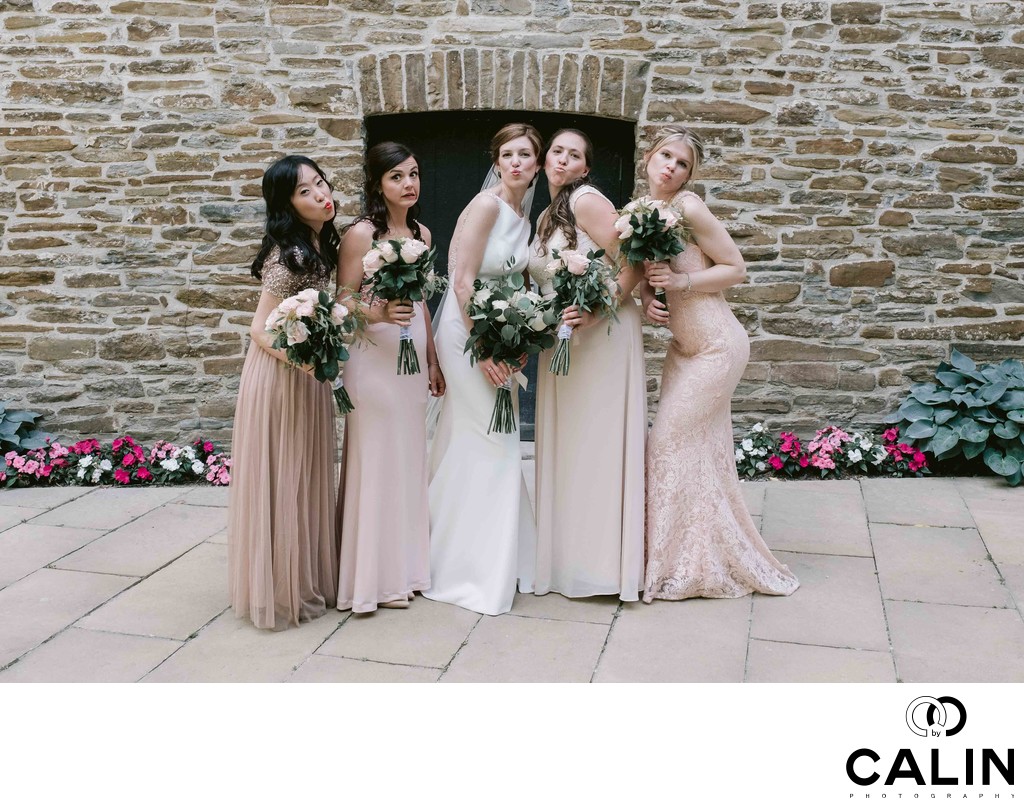

Old Mill Toronto Wedding: The Bridesmaids Portrait I Built Around Confidence, Color, and Real Chemistry
I remember this moment at an Old Mill Toronto Wedding because it happened exactly the way I want bridal party portraits to happen: fast, purposeful, and full of personality. We were moving through the venue’s grounds with that gentle, flattering light you get when the sun is softened by trees and architecture. The bridal party energy was already high—inside jokes, last-second dress checks, someone fixing a strap, someone else laughing at a comment that would never make it into a speech—and I knew I had a window to create something that felt editorial but still honest.
When I’m photographing an Old Mill Toronto Wedding, I’m always looking for a background that adds texture without competing with people. The Old Mill gives me that in a way few venues do: stone, greenery, and timeless lines that feel romantic without feeling staged. My job is to translate that atmosphere into a frame that still puts the human relationships first. That’s the entire point of a bridesmaids portrait—showing who the bride is with when she’s not “performing” for guests, but leaning on the people who’ve been with her through real life.
How I Set Up This Bridesmaids Pose (and Why It Works)
I didn’t “pose” this image in the stiff, old-school way. I directed it. There’s a difference. I placed the group where the light was clean and consistent, then I gave them structure: where to stand, where to angle shoulders, how to stagger heights, and how to connect hands and hips so it reads as one cohesive shape instead of six separate people. Then I let them be themselves inside that structure.
The key instruction I gave was simple: get close enough that you’re sharing air. Bridal party portraits fall apart when people leave space between bodies. Space creates awkwardness. Closeness creates confidence. Once they were tight, I asked them to look at each other for a beat, trade a quick comment, and then snap their eyes back to me. That micro-sequence is where real expression shows up—smiles that look lived-in instead of pasted on.
Camera, Lens, and Technique: What I Used and What I Was Solving
I photographed this on Canon R5 cameras and a Canon RF L-series lens (RF mount). For bridal party work, I favor an L lens because I want dependable contrast, clean color, and sharpness that doesn’t turn skin into harsh texture. I also want fast, reliable autofocus because bridal parties move constantly—someone’s hair shifts, someone laughs, someone leans in—and the expression that matters can be gone in half a second.
From a technical standpoint, the goal was to keep every face crisp while still giving the background a gentle falloff. That’s a depth-of-field balancing act: too shallow and the back row softens; too deep and the scene turns busy. I positioned myself to keep their faces on a similar focus plane, then shot with a moderate aperture choice that preserved detail while still separating them from the environment. I also kept my shutter speed comfortably high—bridal parties sway, shoulders pivot, hands gesture—so the image stays clean and polished.
Lighting-wise, I leaned into what the Old Mill gives naturally. I searched for open shade with directional brightness—soft on skin, but with enough shape to avoid flatness. That kind of light gives me smooth gradients on faces and dresses, and it keeps colors rich. If I need to refine it, I’ll use subtle on-camera or off-camera fill, but my default is to make natural light look intentional rather than “available.”
Composition Choices: Why Your Eye Lands Where It Should
A great bridal party photograph should read instantly. In this frame, the visual hierarchy is clear: faces first, then dresses and body language, then the venue atmosphere. I composed to keep distracting lines from intersecting heads, and I watched the edges of the frame—no random branches, no bright patches pulling attention away. I also built a shape with the group: staggered height, staggered spacing, and a rhythm in posture that keeps the image from feeling like a lineup.
I’m also intentional about micro-details that most people don’t notice until they feel them: how hands rest, whether elbows are tucked or flared, whether chins are slightly forward (it matters), and whether everyone’s weight is on the same leg (it looks rigid) or naturally varied (it looks alive). These tiny corrections are the difference between “we took a picture” and “this is a portrait.”
Why This Is a Great Wedding Photograph (Unequivocally)
This image is great because it does two things at once: it looks refined, and it feels real. The expressions don’t look coached—they look like the last ten minutes of friendship spilling into one moment. The posture is flattering without being fake. The styling reads clearly. The colors complement each other instead of fighting. And technically, it holds up: the light is soft, the focus is decisive, and the frame is controlled.
Emotionally, it works because bridal party photos are not about symmetry—they’re about chemistry. I can feel the closeness in the way they stand, the way they angle toward each other, the way the smiles don’t match perfectly (because real smiles don’t). It’s celebratory without turning into chaos. That’s the sweet spot.
Post-Processing: How I Finished the Image (and Why)
My post-processing approach is about producing a clean, consistent, printable file that still looks like the day—not like a filter. I start with a calibrated color workflow so skin tones stay believable across changing light. From there, I refine exposure globally: I protect highlights in dresses, open shadows on suits, and keep midtones lively so faces feel dimensional.
Next is color shaping. I’ll usually:
- Neutralize skin tones first (removing unwanted green/magenta shifts from shade or reflected foliage).
- Control dress color separation so each bridesmaid color stays distinct without oversaturating.
- Reduce distracting color casts in the background while keeping the Old Mill atmosphere intact.
Then I move into local refinement:
- Selective dodging and burning to shape faces subtly (cheekbones, jawline separation, eye brightness) without making it obvious.
- Texture management that preserves skin detail while smoothing only what distracts—think blemish clean-up, not plastic skin.
- Micro-contrast control to keep fabrics crisp and elegant without turning them crunchy.
- Background taming (subtle vignette, local exposure pulls on bright patches, and gentle clarity reduction behind faces) so attention stays where it belongs.
Finally, I sharpen with intention: capture sharpening for overall crispness, then output sharpening tailored for web so it looks clean without halos. The goal is an image that holds up whether it’s viewed on a phone, printed in an album, or enlarged on a wall.
How This Portrait Fits Into the Full Old Mill Toronto Wedding Story
A bridal party portrait like this isn’t a standalone “nice photo.” It’s a pacing tool in the wedding gallery. It breaks up the ceremony-to-reception flow, it documents relationships, and it gives the couple a set of images that friends will actually share. When I deliver an Old Mill Toronto Wedding collection, I want variety: wide context, tight emotion, editorial portraits, and candid in-between moments that stitch the day together.
If you want to see how I build that variety across the same venue and same wedding day, explore the full set here: Old Mill Toronto Wedding photography gallery. And if you’re looking for a complementary portrait moment with a totally different feel, I love pairing this bridesmaids energy with something softer and more intimate like bride veil portraits at Old Mill Toronto, plus a broader group dynamic in Old Mill Toronto bridal party photo ideas.
What I Want Couples to Take From This
If you’re planning an Old Mill Toronto Wedding, know this: your bridal party portraits don’t need to be stiff, slow, or stressful. When the direction is clear and the light is chosen carefully, we can create images that look polished while still feeling like you. That’s what I’m always chasing—photographs with craft, yes, but also photographs with truth.