
Old Mill Toronto Wedding: The First Kiss I Wait For All Day
There’s a specific kind of quiet that happens right before a first kiss at an Old Mill Toronto Wedding. It’s not silence—there are still guests shifting in the pews, a soft breath from someone trying not to cry, the faint rustle of fabric— but the room tightens in attention. As the photographer, I feel it in my hands: the smallest pause before everything becomes memory.
The split-second that tells me the kiss is coming
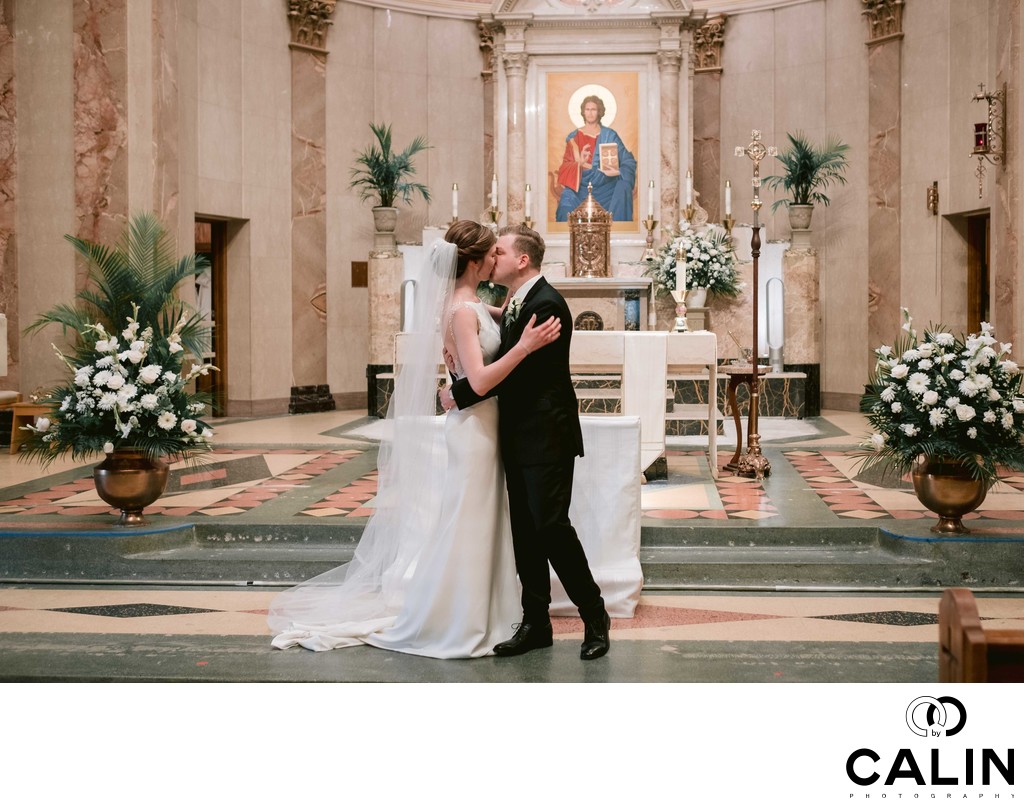
I can always tell when it’s about to happen. The officiant’s cadence changes, the couple’s shoulders lift in that shared inhale, and the groom’s posture turns protective without trying. The bride’s veil settles after a tiny movement of her head. And then—eyes close, distance disappears, the room exhales. In this frame, I’m not chasing a pose. I’m preserving a commitment made visible.
What I love most about photographing ceremonies at the Old Mill area is how the environment supports emotion instead of competing with it: warm stone, classic architecture, and a sense of history that makes the moment feel grounded. When the couple leaned in here, it didn’t feel staged. It felt inevitable.
How I made this photograph (and why my position mattered)
I created this image from the center aisle with intention. The aisle is the most honest vantage point for a first kiss: it gives symmetry, context, and a direct emotional line to the couple’s faces. I stayed far enough back to let the scene breathe, but close enough that the kiss still reads as the main subject instead of getting lost in the room.
The altar details matter, too. The white florals and candles act like visual punctuation marks—quiet, elegant accents that reinforce the ceremony without pulling attention away from the couple. I watched the bride’s veil and bouquet position carefully; anything that intersects awkwardly with the groom’s jacket or the altar decor can distract. Here, everything supports the center: two people choosing each other in front of everyone they love.
Camera, lens, and the exact look I was building
I photographed this on a Canon R5, and I built the look with a Canon RF L-series lens. For ceremonies, I rely on Canon’s RF L glass because it gives me reliable autofocus, strong contrast, and clean color—especially in mixed indoor light. In a moment like this, I’m not interested in “good enough.” I’m interested in repeatable precision when the moment happens only once.
The perspective here reads like a mid-range focal length rather than an ultra-wide: the couple is prominent, the altar is present, and the lines of the architecture feel natural. This is the kind of scene where I want minimal distortion and flattering proportions, because the kiss is intimate and the setting is formal. A ceremony photograph should feel respectful. My lens choice and distance are part of that respect.
Lighting, composition, and depth of field (the technical decisions you can feel)
Indoor ceremony light can be tricky because it’s often a blend of overhead ambient illumination and warmer practical sources—candles, sconces, reflective stone surfaces. In this image, I embraced the softness instead of fighting it. I exposed to protect the bride’s dress highlights while keeping enough shadow detail in the groom’s suit to retain texture and shape.
Compositionally, this is structured to feel ceremonial: the couple is centered, framed by florals on both sides, and anchored by the altar behind them. The columns and architecture act like leading lines that pull the viewer straight into the kiss. Depth of field is shallow enough to separate the couple from the background, but not so shallow that the church context turns into meaningless blur. I want the viewer to recognize where this happened, not just what happened.
Why this is a great wedding photograph (in plain, unequivocal terms)
This is a great wedding photograph because it does two hard things at once: it delivers emotion and it delivers structure. The emotion is obvious—the kiss is real, not performed. But the structure is what makes the emotion land. The symmetry, the framing florals, the warm architectural backdrop, and the steady perspective create a visual “stage” where the couple becomes the undeniable focal point.
Technically, it’s strong because the exposure is controlled (the white dress holds detail), focus is placed where it matters (the couple, not the decor), and the color palette feels intentional (warm neutrals and clean whites that suit a formal ceremony). Artistically, it’s strong because the photograph gives the moment dignity. It doesn’t sensationalize it. It honors it.
And from a storytelling perspective—the part most people can’t name but always feel—this frame contains context. The altar, the florals, the candles, the architectural lines: they’re not background clutter. They’re proof. Proof that this happened in a meaningful place, in front of people who mattered, on a day that will be talked about for decades.
How I processed this image (the full postproduction approach)
My postprocessing goal for an Old Mill Toronto Wedding ceremony image is always the same: preserve the truth of the moment, then refine the viewing experience so nothing distracts from the emotion.
First, I corrected overall exposure and contrast with careful highlight recovery to protect the gown and veil while lifting shadows just enough to keep the groom’s suit from becoming a flat silhouette. Then I refined white balance to keep skin tones natural under warm interior lighting; churches can push yellow/orange casts, so I neutralize selectively rather than globally.
Next came targeted tonal shaping: gentle dodging on faces and hands to emphasize connection, and subtle burning around the edges to keep the eye centered on the kiss. I also apply controlled micro-contrast where it helps (lapels, bouquet edges, facial contours) without making the dress texture look harsh.
Color work is intentionally restrained: I maintain clean whites, keep florals soft and elegant, and ensure the background warmth supports the scene instead of turning muddy. Finally, I finish with consistent sharpening optimized for the subject (eyes/edges) and noise control that keeps the image smooth while preserving detail in the architecture. The objective is clarity without brittleness—romance without haze.
More from this Old Mill Toronto Wedding
If you want to see how I build the full story around moments like this—ceremony angles, reactions, and the way the day flows—view the complete set here: Old Mill Toronto Wedding album.
For a closer look at how I photograph formal moments with flattering perspective and calm direction, see: Old Mill Toronto wedding ceremony portraits.
And for the energy right after the ceremony—the relief, the laughter, the “we did it” feeling—see: happy newlyweds at the Old Mill in Toronto.