
Old Mill Toronto Wedding: The Bridal Party Photo That Said Everything Without Saying a Word
I’ve photographed a lot of wedding days in Toronto, but there’s a particular kind of energy that shows up when I’m shooting an Old Mill Toronto Wedding—equal parts classic, romantic, and just a little bit mischievous. This frame is from one of those days where the timeline was on track, the nerves had settled, and the bridal party finally had permission to be themselves.
What was happening when I took this photo
We had already handled the “must-have” combinations—families, formal bridal party groupings, the clean editorial portraits. At that point, I always look for the moment when everyone unconsciously exhales. That’s when the images stop being about posing and start being about personality.
We stepped into a courtyard space beside the Old Mill’s Tudor-style architecture, framed by greenery and a wall of pink blossoms. The light was soft and even—no harsh sun cutting across faces—so I knew I could work quickly without forcing anyone to rotate inches at a time for “perfect light.” Instead of slowing them down, I gave them one simple direction: make it fun, but stay connected as a group.
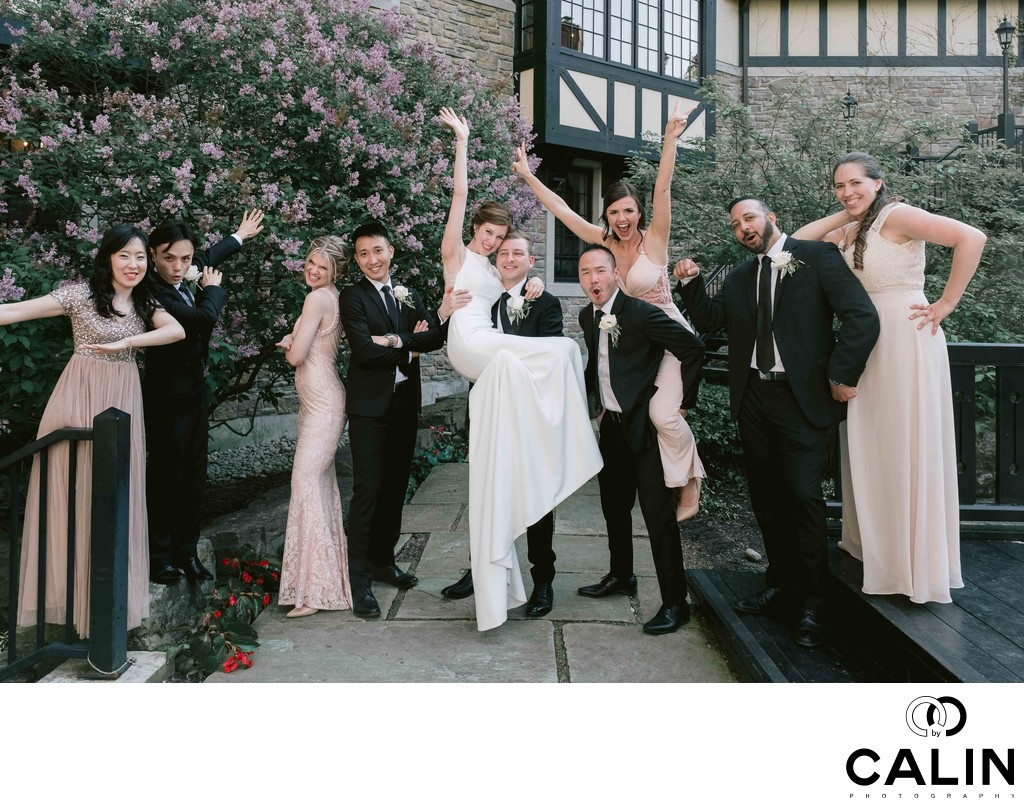
Within seconds, the bridal party turned the volume up. Two lifts happened almost at once, arms went up, expressions became real, and suddenly the photo turned into a mini-celebration. That’s the heartbeat of the day: not the performance of joy, but actual joy.
Everything I see in the frame (and why it works)
The group is eight people: four in dark suits and four in long gowns in soft, warm tones—white, blush, peach, and pink. The styling matters because it gives me immediate color harmony. The florals behind them echo the pastel palette, and the building’s warm wood-and-stone feel keeps the scene grounded rather than overly “garden bright.” The result is a layered background that supports the subject instead of competing with it.
The pose is intentionally chaotic, but it’s structured chaos. Two people are lifted, creating vertical movement and an instant focal point. Raised arms add a celebratory shape that reads from far away (important for albums and wall art). Everyone else is still engaged—no one looks like they’re waiting for it to be over. That’s the difference between a staged “fun pose” and a moment that actually feels fun.
Gear and lens choice (Canon R5 + Canon RF L-series)
I shot this with Canon R5 cameras, and this image has the look of a standard-to-slightly-wide perspective—wide enough to include the environment, but not so wide that faces distort at the edges. For a scene like this, I lean on Canon RF L-series glass because it locks focus fast, renders clean color, and stays sharp even when I’m moving quickly to catch a split-second expression.
When bridal party energy spikes like this, my priority is reliability: fast autofocus, consistent exposure, and a focal length that lets me stay close enough to feel the moment while still keeping the group together in one frame.
Photographic techniques I used (composition, light, and timing)
Lighting: This is soft natural light—likely overcast or open shade—so shadows are gentle and skin tones stay smooth without me needing to fight contrast. That kind of light is flattering for everyone in the frame and keeps attention on expressions instead of highlight hotspots.
Composition: I shot straight-on at roughly eye level, keeping the group centered and the background readable. The flowering bush becomes a textured backdrop, and the Old Mill’s architectural details hint at place without stealing the scene. The two lifts create a strong “peak” shape that gives the image instant structure.
Depth of field: I kept enough depth of field to hold the entire bridal party sharp while still separating them from the background. For group photos, sharpness across faces is non-negotiable—especially when the pose is dynamic and people are at slightly different distances from the camera.
Timing: This is the real craft here. The moment isn’t just “people lifted.” It’s the exact beat where arms are fully extended, smiles are genuine, and the rest of the group is reacting—not checking if they’re doing it right.
Why this is a great wedding photograph (my unequivocal critique)
This image is great because it’s emotionally honest and technically controlled at the same time. The energy is obvious: you can feel that the bridal party is celebrating the couple, not performing for the camera. That emotional impact is the whole point of wedding photography—if the photo doesn’t make you feel the day, it’s just documentation.
Technically, it succeeds because nothing essential is compromised by the spontaneity. The exposure is even, the color palette is cohesive, faces remain readable, and the background supports the story. The environment says “Old Mill” without turning into a postcard. And most importantly: the frame has layers—foreground emotion, midground connection, background context—so it holds your attention longer than a typical “everyone line up and smile” group shot.
A lesser version of this photo would have one lifted person sharp and the rest drifting, or it would have messy spacing where half the group feels disconnected. Here, the spacing stays tight enough to communicate unity, while the gestures stay big enough to communicate celebration.
How I processed the image (detailed post-production approach)
My editing goal for an Old Mill Toronto Wedding is always the same: keep skin tones natural, keep greens believable, preserve the warmth of the venue, and make the moment feel exactly as it did.
In post, I focused on: white balance refinement to keep the whites in the dresses clean without turning the scene cold; highlight control to protect bright fabric and keep detail in lighter areas; shadow lift with restraint so the dark suits hold texture and don’t block up; selective color tuning to keep pink blossoms vibrant but not radioactive; global contrast shaping for a crisp, modern look while avoiding harsh edges on skin. I also apply lens profile corrections to maintain straight lines and reduce subtle vignetting, then finish with targeted sharpening on faces and hair while keeping background texture slightly softer so attention stays on people.
Finally, I do small, invisible cleanups: minor distractions in the background, tiny skin-tone inconsistencies caused by mixed reflections from greenery, and micro-adjustments to luminance so every face reads clearly. The objective isn’t to “stylize” the moment—it’s to present it with clarity and polish while keeping it real.
Bridal party photos at the Old Mill: how I guide this kind of moment
If you want bridal party images that feel like this, the secret isn’t a complicated pose list. It’s permission and pacing. I build a foundation of classic photos first, then I intentionally create a short window for fun—because once people trust that we “got the formal ones,” they stop self-editing.
And when the bridal party is ready for that shift, I’ll often move into a spot like this courtyard where the background is beautiful, the light is forgiving, and the space feels private enough for people to be a little louder than they normally would be.