I’ve photographed a lot of formal lineups—clean suits, straight ties, everyone doing the “serious” face because that’s what the timeline says we need. But at this Old Mill Toronto Wedding, the groomsmen were the kind of group that made the room feel lighter the second I walked in. Not loud for the sake of it—more like they were genuinely at ease with each other. That comfort is gold to me, because it means I can push beyond “posed” and into something that actually reflects who they are.
By the time we got to this moment, we’d already handled the essentials: the classic portraits, the jacket-button adjustments, the tie straightening, the quick checks that everyone looked sharp. Then I noticed the smallest tell: a couple of them kept glancing at their phones between takes—nothing dramatic, just that modern habit of staying connected even on a day like this.
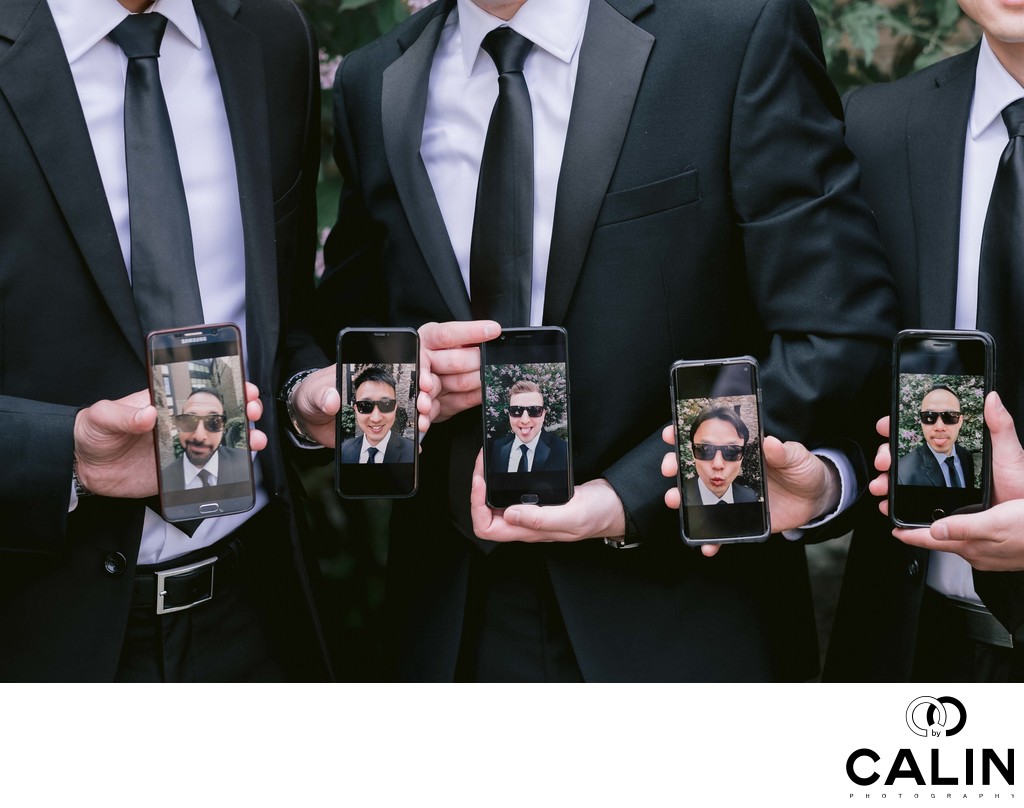
I decided to lean into it instead of fighting it. I asked them to pull out their phones and hold them up in a straight line, shoulder to shoulder, like they were building one continuous strip across the frame. The goal wasn’t to make technology the “theme.” The goal was to show their unity—how each guy is one piece of the support system around the groom. When they raised their phones together, the energy shifted: suddenly they were collaborating, laughing, checking alignment, helping each other out. That’s when I pressed the shutter—right in the middle of that shared momentum.
The final image is exactly what I want from groomsmen coverage: formal attire, yes, but with an unmistakable sense of real friendship and an inside-joke vibe that a stiff lineup could never deliver. The photo itself shows the group in black suits with white shirts and black ties, each holding a smartphone toward camera, creating a unified visual band across the composition. The background is softly blurred so nothing competes with the gesture. The light is clean and natural, and the framing is tight enough to feel intentional, not accidental. Old Mill Toronto Wedding photography gallery.
On the surface: six well-dressed guys holding phones. Underneath: a visual metaphor for how a groom gets to the ceremony with confidence. Each phone becomes a “tile” in the story—like each friend is carrying a piece of the day with him. The suits signal the formality of the occasion, but the phones signal the relationship: contemporary, casual, unforced.
From a photographer’s point of view, what makes it work is the contrast. The styling is classic and refined—black jackets, crisp shirts, dark ties—while the concept is playful and current. That tension creates impact. It feels like a wedding, but it doesn’t feel like a checklist.
I shot this on a Canon RF camera body paired with a Canon L-series RF mount lens. For a frame like this, I want three things: fast, reliable autofocus; strong micro-contrast so black suits don’t turn into a flat mass; and the option to control depth of field precisely.
If you’re asking me to name the exact type of lens I’d pick for this: a mid-range prime in the Canon RF L lineup is ideal—something like the look and behavior you get from a 50mm-class L prime. That focal length keeps faces natural, avoids the stretched edges you’d risk with a wider lens, and still lets me work close enough to feel present with the group.
The key here is that I’m not chasing “blur for blur’s sake.” I’m choosing optics that let me separate the subjects from the environment while preserving texture—especially in formalwear where the details matter.
This image succeeds because the lighting stays honest. I used bright, natural light—clean enough to keep skin tones accurate and soft enough to avoid harsh shadow edges. The suits hold detail instead of collapsing into pure black, which is a common failure point when photographers underexpose dark fabric.
The tricky part is the phones. Phone screens can spike highlights fast, and if I expose for faces without thinking, the screens blow out and become meaningless rectangles. So I expose with the entire tonal range in mind: I protect highlights on the screens while keeping the suits rich and dimensional. In practical terms, that means watching the histogram, keeping an eye on specular hotspots, and positioning the group so the ambient light stays flattering rather than top-down.
I composed this to be read as a single, bold gesture across the middle of the image. The phones form a strong horizontal line—graphic, rhythmic, and instantly understandable. That line becomes the anchor, while the hands and suit sleeves create repeating shapes that reinforce the idea of unity.
I kept the background soft and non-competitive on purpose. At the Old Mill, there are always beautiful textures and architectural cues, but in this particular frame, the venue is meant to be felt—not inspected. The blur gives context without stealing attention.
Most importantly, the crop is confident. There’s no “extra air” that waters it down. The tighter framing makes it feel like you’re standing right there with them—close enough to hear the jokes they’re making while they line everything up.
I’ll say it plainly: this is a great wedding photograph because it delivers emotion with structure.
Emotion, because the concept only works if the group trusts each other enough to commit to it. You can sense that willingness—there’s no hesitation in the body language. It reads as genuine camaraderie, not performance.
Structure, because the frame is designed. The lighting is controlled, the composition has a clear visual hierarchy, and the depth of field is used to simplify the scene. The technical choices are not “showy,” but they are precise—and that precision is what lets the playful idea land without looking messy.
A weaker version of this photo would have clutter behind them, uneven exposure across the screens, or a focal length that distorts the men at the edges. Here, everything supports the idea. Nothing competes with it. That’s the difference between a fun snapshot and a finished wedding image.
My editing approach starts with one rule: keep it believable. At an Old Mill Toronto Wedding, the atmosphere is classic, and the processing should respect that—clean contrast, natural skin, deep blacks that still hold texture.
I begin in Lightroom (or Camera Raw) by setting a consistent white balance that preserves neutral shirts and accurate skin. Then I build contrast with a gentle tone curve—enough to give the suits depth without crushing shadow detail. I lift the deepest blacks slightly so the jackets still show fabric texture and seam lines, and I manage highlights so the phone screens don’t clip into pure white.
The screens get local adjustments: highlight recovery and selective exposure control to keep them legible. I’ll often add a touch of clarity or micro-contrast to the screens only, so the viewer immediately understands what the phones are doing in the frame. This is masked carefully—if I apply global clarity, skin and suits can start to look crunchy.
Black suits photograph beautifully when they’re handled with restraint. I add texture selectively to emphasize the tailoring without creating a “gritty” look. Then I fine-tune the blacks so they feel rich—more like ink than gray—while still preserving separation between lapels, sleeves, and hands.
I correct any minor redness or unevenness with subtle HSL adjustments and gentle local brushing. If I go into Photoshop, I’ll use frequency separation sparingly—only to reduce small distractions while keeping real skin texture intact. Hands stay real. Faces stay real. The goal is polish, not perfection.
I remove tiny distractions (lint, specks, minor reflections) with healing tools. Then I apply sharpening in stages: global sharpening for overall crispness, plus targeted sharpening where it matters most (the phones and key edges). If the image benefits from it, I’ll add a very light grain to unify tones and keep the photograph feeling organic rather than overly digital.
When couples look back on their wedding photographs, they don’t only want proof that everyone showed up in matching suits. They want reminders of how it felt—the nerves, the pride, the loyalty, the laughter that steadied everything before the ceremony.
That’s why I make space for images like this during an Old Mill Toronto Wedding. The venue can carry elegance all on its own, but the real legacy of the day lives in moments like this: a group of friends choosing, collectively, to show up for one of their own.
If you want to see how I build a full visual narrative around the groom’s side of the day—from details to portraits to moments like this—start here: groom wedding details and arrangement. And if you’re planning your own celebration and want a better sense of spaces, light, and flow, this is the venue guide I reference often: Old Mill wedding venue.
