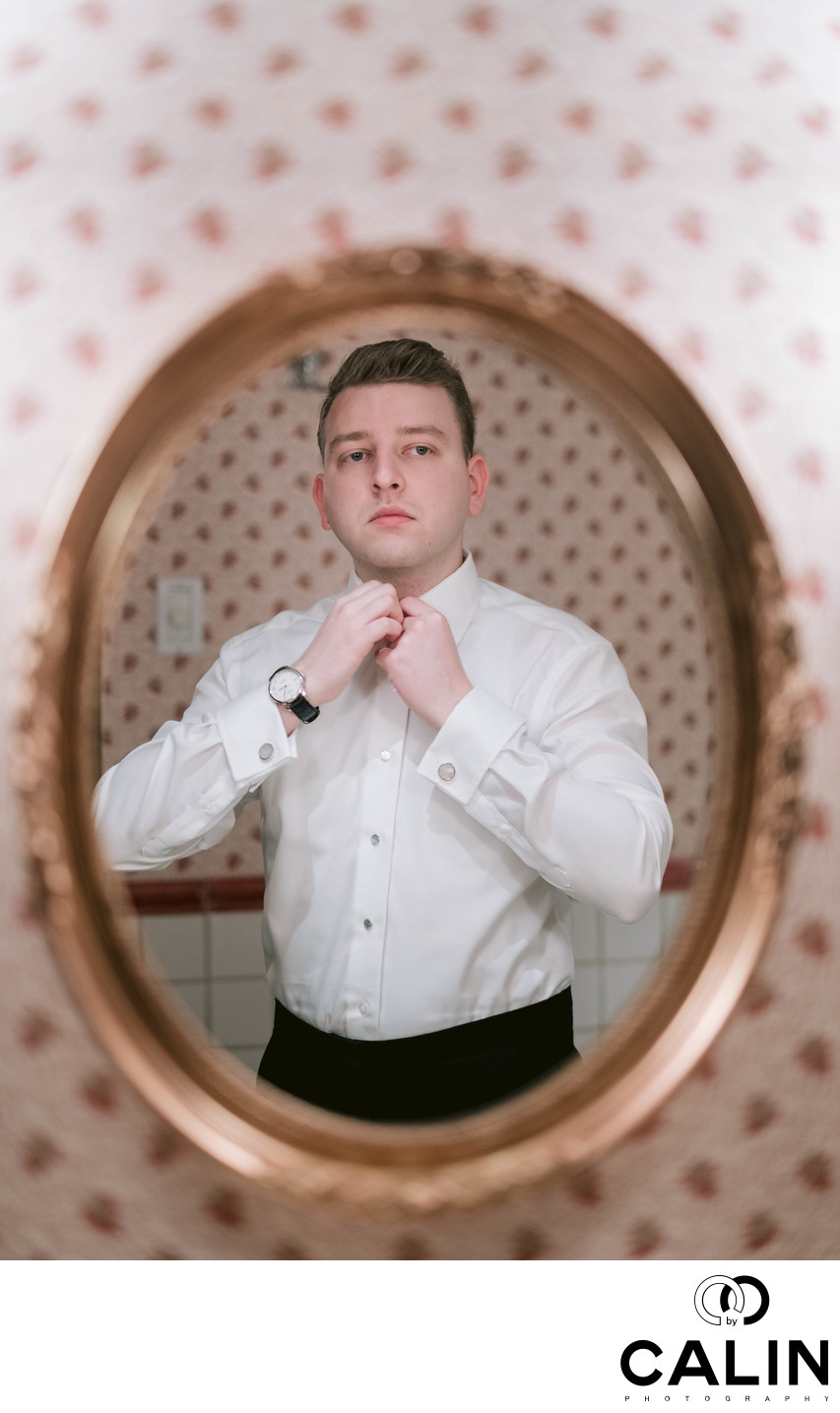

Old Mill Toronto Wedding: A Groom’s Quiet Confidence, Captured in One Frame
There’s a particular kind of calm that shows up in the minutes before a ceremony—the kind that isn’t performative, isn’t loud, and doesn’t need an audience. At an Old Mill Toronto Wedding, that calm feels even more grounded, because the building itself carries a sense of history and permanence. When I photographed this groom getting ready, I wasn’t chasing a “moment” as much as I was protecting it—giving it space, shaping the light, and letting the story surface naturally.
How I Set the Scene for This Old Mill Toronto Wedding Portrait
I remember stepping into the room and immediately noticing how the light behaved—soft, directional, and flattering, the kind that makes you slow down and shoot with intention. The groom had already done the hard part: he arrived emotionally present. He wasn’t rushing, and he wasn’t distracted. He looked prepared, not just dressed. That matters.
My approach in moments like this is simple: I minimize interruptions, I keep my voice low, and I let the rhythm of the room dictate the pace. I don’t “manufacture” confidence; I photograph the real version of it. I watched him settle his posture, take a breath, and briefly lock into that internal focus people get right before something life-changing happens.
This is exactly why I love photographing an Old Mill Toronto Wedding gallery: it’s a venue that supports story-driven imagery—strong textures, elegant interiors, and light that can be sculpted rather than fought.
What You’re Seeing in the Photograph (And What I Was Looking For)
In the frame, the groom is the anchor. The image reads as composed but not stiff—his expression carries ease, and the styling feels intentional without pulling attention away from him. The background stays present enough to provide context, yet it doesn’t compete. That balance is the entire goal of a great getting-ready portrait: it should feel like him, not like a catalog.
When I’m photographing groom prep, I’m always watching for three things: clean light on the face, a posture that feels natural, and a background that quietly supports the narrative. If any one of those collapses, the image turns from “story” into “snapshot.” Here, everything stayed aligned.
Camera, Lens, and Why I Chose This Look
I shot this on a Canon RF camera body paired with a Canon RF L-series lens (RF mount). For this kind of portrait, I’m usually reaching for an RF L prime—most often the Canon RF 50mm f/1.2L or Canon RF 85mm f/1.2L—because they give me two crucial things: edge-to-edge character and a depth-of-field that feels cinematic without looking gimmicky.
The perspective in this frame suggests a flattering short-telephoto feel: enough compression to keep the subject elegant, while still allowing the environment to read. I want the viewer to feel close, but not invasive. That “present-but-respectful” distance is a big part of my style during an Old Mill Toronto Wedding morning.
Lighting, Composition, and Depth of Field (My Technical Choices)
The light is doing the heavy lifting here. I worked with available window light—soft, directional illumination that shapes the face without harsh shadow edges. I positioned him so the light would skim across his features, giving dimension while keeping skin tones clean and natural. This approach avoids the flatness that overhead room lighting often creates.
Compositionally, I kept the frame uncluttered and let the groom occupy visual priority. I’m always managing lines and contrast: if there’s a bright patch behind the head, it steals attention; if there’s a strong line cutting through the subject, it creates tension for the wrong reason. Here, the background reads as environment, not distraction.
Depth of field is shallow enough to separate him from the room, but not so thin that the image becomes “about blur.” That’s an important distinction. A great wedding portrait uses blur as a tool, not as a subject.
Why This Is a Great Wedding Photograph (My Unequivocal Critique)
This is a great wedding photograph because it delivers both emotional clarity and technical control at the same time. Emotionally, the groom reads as calm, confident, and genuinely happy—there’s no forced grin, no over-direction, no performance. That authenticity is rare, and when it’s present, it elevates the entire wedding story.
Technically, the image succeeds because nothing is accidental: the exposure protects highlights, the face is cleanly lit, the background is controlled, and the focus choice supports the narrative. The framing feels deliberate, and the shallow depth-of-field enhances subject separation without turning the scene into a blur-fest. This is what I’m always aiming for at an Old Mill Toronto Wedding—story first, craft always.
Most importantly, the photograph has staying power. It won’t feel trendy in five years. It will still read as timeless because it’s built on fundamentals: light, expression, composition, and restraint.
The Story Behind the Moment (As I Experienced It)
He didn’t fill the room with noise—he filled it with intention. The tie was already chosen, the suit sat perfectly, and the details around him felt quietly coordinated. I could tell the couple had planned with care, but what struck me most was how unbothered he was by the pressure of the day. He looked like someone who wasn’t just ready to get married—he was ready to be married.
I took a few frames as he adjusted and settled, then paused. I’m always watching for that micro-shift—when the shoulders drop a touch, when the expression softens, when the person stops “being photographed” and simply is. That’s when I press the shutter with confidence.
If you want to see how I build this kind of story from the smallest elements outward, the groom’s accessories and styling details matter just as much as the portrait itself. That’s why I also photograph and curate moments like groom wedding details at Old Mill Toronto—they’re the supporting paragraphs to the main scene.
Post-Processing: Exactly How I Finished This Image
My editing goal was to keep the image honest while refining it to match how it felt in the room. I process wedding portraits like this with a clean, natural workflow that prioritizes skin tone accuracy, controlled contrast, and consistent color.
Here’s what I did in post, step-by-step: 1) Exposure balancing: I fine-tuned overall exposure to preserve highlight detail while keeping midtones rich. I lifted shadows gently to retain suit texture without turning blacks gray. 2) White balance and color calibration: I neutralized any mixed-light contamination and ensured skin tones stayed natural (no orange casts, no green shifts). I adjusted tint subtly so whites stayed clean without going sterile. 3) Contrast shaping: I used a soft S-curve to add depth, then selectively reduced contrast in areas that could become harsh (typically under-eye shadows or suit edges near the light falloff). 4) Local adjustments: I dodged the face and key suit lines with restraint to guide the eye, and I burned distractions in the background to keep attention locked on expression. 5) Skin retouching (natural finish): I removed temporary blemishes and evened small tonal inconsistencies while protecting pores and texture. No plastic skin, no smeared details. 6) Detail and sharpening: I applied sharpening primarily to the eyes, lashes, and key fabric edges. I kept background sharpening minimal so the separation stayed clean. 7) Color grading: I refined the palette to feel warm and classic—subtle warmth in highlights, controlled saturation in skin, and disciplined color in the shadows so the image doesn’t drift muddy. 8) Final polish: I checked for micro-distractions (bright corners, specular hotspots) and corrected them so the frame feels finished without looking “edited.”
How This Portrait Fits Into the Full Wedding Story
For me, a great Old Mill Toronto Wedding isn’t just ceremony and reception—it’s the full arc: anticipation, calm, energy, and connection. This portrait is the quiet chapter that makes the louder chapters hit harder.
And when the guys finally link up—when the nerves turn into laughter and the room shifts from prep to celebration—I’m ready for that too. Those scenes belong beside the calm portraits, because they’re part of the same truth. If you want that side of the day, it pairs perfectly with groomsmen drinks at Old Mill Toronto.