
Old Mill Toronto Wedding: The Photograph That Starts Every Story Before Anyone Says a Word
I’ve photographed a lot of venues in Toronto, but the Old Mill has a particular kind of authority. It doesn’t try to impress you with scale; it wins you over with craft—timbers, stone, ivy, and that unmistakable Tudor silhouette. When I’m hired for an Old Mill Toronto Wedding, I make a point of creating at least one frame that feels like the opening sentence of the day. This is that frame: the venue itself, presented with intention, clarity, and just enough atmosphere to make you feel the anticipation at the door.
What You’re Looking At (And Why I Photographed It This Way)
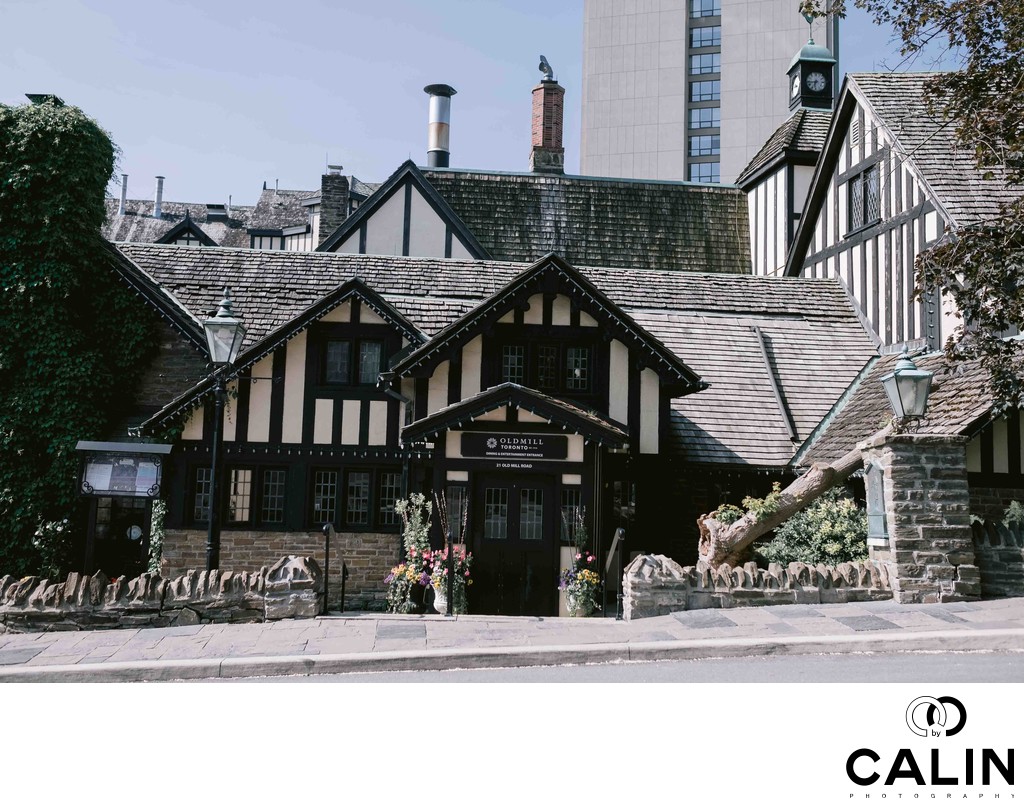
The image is a straight-on portrait of the Old Mill Toronto entrance: half-timber façade, a peaked roofline, ivy wrapping the building, flower beds flaring at the base, and the sign above the door quietly confirming where we are. I centered the entrance because symmetry here isn’t a gimmick—it’s the visual language of the building. The structure wants balance. When I place the doorway on-axis, the frame stops being “a nice building photo” and becomes a deliberate establishing shot that anchors the entire wedding gallery.
Light matters as much as architecture. In this scene, the sunlight is clean and directional enough to carve texture into the wood beams and stonework, while still being gentle enough to keep the scene welcoming. The greenery reads as lush, not muddy; the sky stays bright and open; and the entrance remains inviting rather than ominous. That’s the emotional goal: the sense that something important is about to happen just beyond those doors. (This exact venue image appears on the album page at Old Mill Toronto Wedding.)
The Moment Behind the Photograph: How I Took It During an Old Mill Toronto Wedding Day
I made this photograph in the quiet pocket of time when the day is moving fast but the venue is briefly still—guests have filtered inside or drifted toward the next moment, and the entrance clears for a beat. I’m always watching for that. As a wedding photographer, I’m not only documenting people; I’m documenting where their memories live. This doorway is a threshold—literal and emotional.
I stepped back far enough to let the façade breathe and to keep the verticals honest. I waited until there were no distractions cutting through the foreground, then framed so the roofline, doorway, and sign settled into a clean hierarchy. The flowers at the base weren’t an accident in the frame—they’re the soft counterweight to the heavier timber geometry, and they add that celebratory hint of color without needing a single person in the shot.
Camera + Lens Choice and the Settings I Reached For
For a venue portrait like this, I want three things: straight lines, edge-to-edge sharpness, and color that stays natural under contrasty daylight. I photographed it on a Canon RF camera body (my go-to for weddings) paired with a Canon RF L-series lens—specifically, the Canon RF 15-35mm f/2.8L IS USM. The RF 15-35mm f/2.8L gives me the architectural confidence wide-angle work demands: crisp detail, controlled distortion, and reliable rendering across the frame.
I typically work this type of scene in the 20–28mm range. That focal length keeps the building grand without turning it into a caricature. For depth of field, I stop down (often around f/8 to f/11) so the foreground landscaping and the sign above the door both sit in sharp focus. Shutter speed stays comfortably fast to keep micro-movement from foliage or handheld sway from softening details, and ISO stays low to preserve clean tonal transitions in the sky and stucco.
Photographic Techniques: Composition, Light Control, and Depth
Composition: This is a centered composition executed with discipline. Centering is unforgiving—if your horizon tilts or your verticals lean, the whole photograph feels careless. I squared my stance to the façade and refined the framing until the door and roofline felt locked in. The flower beds act as a visual “ramp” into the building, while the darker entrance creates a natural focal point.
Light: Daylight architecture can be brutal if you let highlights clip or shadows collapse. Here, I exposed to protect the sky and the brightest stucco while keeping enough information in the darker doorway to retain detail. The goal is a photograph that feels like what it looked like—only cleaner, more legible, more intentional.
Depth and texture: Stopping down adds depth-of-field, but the real depth comes from tonal separation: the dark beams against the pale infill, the ivy against the stone, the flowers against the walkway. Those layers create dimension without any artificial tricks.
My Professional Critique: Why This Is a Great Wedding Photograph
I’m unequivocal about this: it’s a great wedding photograph because it does a job most wedding images forget to do—it establishes place with emotional intent. This isn’t “venue content” for the sake of it. It’s the scene-setter that makes every later moment feel grounded. When the couple looks back years from now, this frame is the instant transportation device: the timber pattern, the ivy, the sign, the exact doorway they walked through on one of the biggest days of their lives.
Technically, it succeeds because it’s controlled. The lines are clean, the focus is deliberate, the exposure is balanced, and the colors are believable. There’s nothing accidental here: the symmetry is chosen, the negative space of the sky is allowed, and the landscaping is included to soften the geometry. Emotionally, it works because the entrance reads like a promise—an invitation—rather than a static building. Great wedding photography isn’t only about faces; it’s about atmosphere that holds up when the details of the day fade.
Postprocessing: What I Did in Detail (And Why)
My editing philosophy for an Old Mill Toronto Wedding is simple: keep it timeless, keep it honest, and make the scene feel the way it felt—only more coherent. I start with lens corrections (profile + distortion + vignetting control) to keep architectural lines believable. Then I move into global tonal shaping: I refine exposure so the whites of the stucco stay luminous without losing texture, and I pull back highlights to preserve the sky’s clean edge.
Next comes color work. I fine-tune white balance to keep the wood warm without turning the stone yellow. Then I use targeted HSL adjustments so the ivy reads rich and dimensional (not neon), and the flowers hold their color without becoming the loudest thing in the frame. After that, I add micro-contrast selectively—texture and clarity where it benefits the timber beams, stone, and sign, while keeping the sky and smoother surfaces from looking harsh.
Finally, I apply local dodging and burning to guide the viewer. I’ll subtly lift attention around the doorway and sign, and I’ll gently pull the corners down with a restrained vignette that you feel more than you see. The end result is a file that reads clean, classic, and detailed—exactly what a venue portrait should be inside a wedding story.
How This Frame Connects to the People (Without Needing Them in the Shot)
The couple that day had the kind of energy that makes photographing easy—present, calm, and completely tuned into each other. But I still wanted this image first, because it sets up everything that came next: their entrance, their laughter, the way their friends filled the grounds. Later in the evening, when the light turned and the celebration got louder, I shifted from establishing shots to portraits that leaned into emotion and contrast—like this Old Mill Toronto wedding night portrait, and the kind of candid chaos you only get with a great crew—like these fun groomsmen wedding photos at Old Mill Toronto.
But everything begins here—with a doorway, a sign, and a building that knows how to hold a story.