
Old Mill Toronto Wedding: The Hug That Said Everything (From Behind My Canon R5)
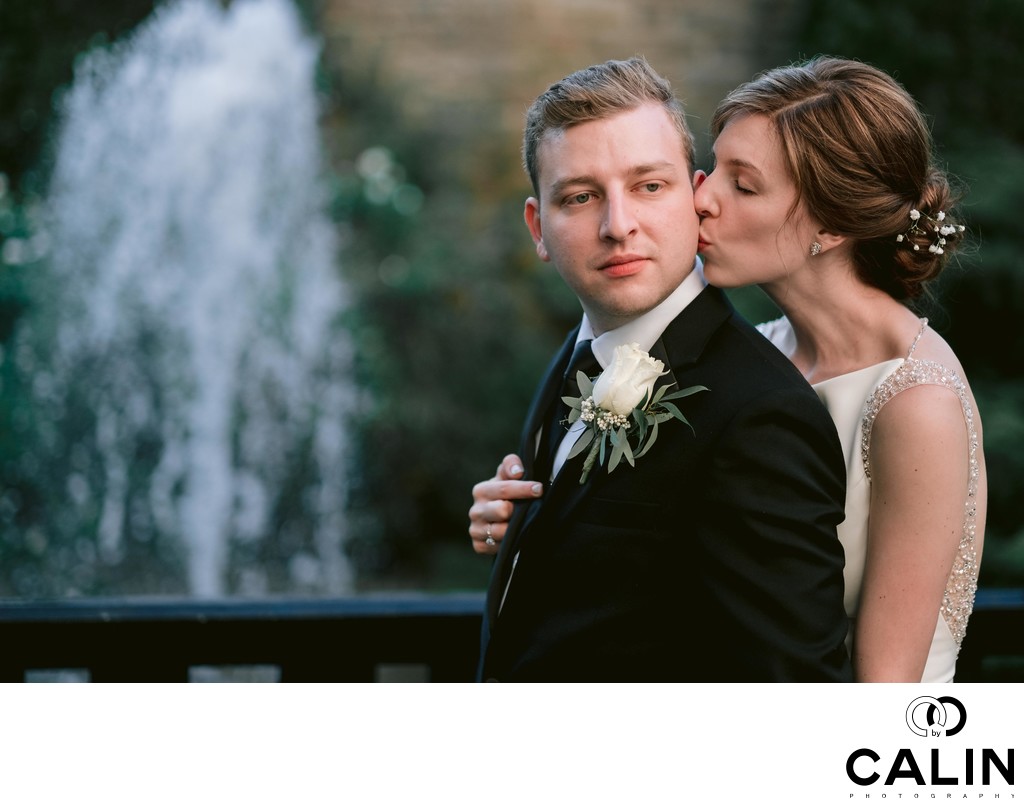
There are moments at an Old Mill Toronto Wedding that happen so quickly they barely register in the room—but through my viewfinder, they land with the weight of a whole chapter. This was one of those moments: a bride wrapping herself around her groom, her cheek pressed in close, her lips finding his face in the kind of kiss that isn’t performed for anyone. It’s private, even with me standing there. My job is to photograph it without interrupting it.
Where This Moment Happened: The Courtyard Energy I Look For
I photographed this during portrait time in the courtyard, with the fountain softly present behind them—an unmistakable Old Mill cue that gives the frame a calm, romantic anchor. The background isn’t loud; it’s supportive. I want the location to feel like it’s holding the couple, not competing with them. In this frame, the fountain’s shape and tone create atmosphere while staying respectfully out of the way. Old Mill Toronto Wedding photography at the courtyard.
What I remember most is how quickly they shifted from “standing for photos” to “forgetting I exist.” That’s the transition I’m always chasing. When a couple stops thinking about where to put their hands and starts reacting to each other, the images stop being poses and start being proof.
The Direction I Gave (And Why I Didn’t Push for a Kiss)
If I’m being honest, I didn’t ask for a kiss here. I asked for a hug. I do that deliberately, especially at an Old Mill Toronto Wedding where the courtyard light can be gorgeous but the mood is often more classic than flashy. A hug is softer and more believable. It gives the bride permission to lean in without feeling like she has to “perform romance.” And once the hug is real, the kiss—if it happens—arrives naturally instead of on command.
In this moment, her embrace did exactly what I hoped: it brought them chest-to-chest, slowed their breathing, and created a quiet pause. And then she kissed him on the cheek. Not big, not staged—just affectionate. I didn’t need anything more than that. I just needed to be ready for it.
Technical Breakdown: How I Shot This on Canon R5 + Canon RF L-Series
I shot this on a Canon R5 using a Canon RF L-series lens. When I’m working in a courtyard like this, I want two things at the same time: flattering compression and a background that simplifies into shape and tone. This kind of image benefits from a portrait focal length that keeps the couple dominant in the frame while the environment becomes a gentle wash behind them.
My approach here is controlled but quick. I’m watching for micro-expressions—eyes softening, shoulders dropping, the bride’s hands tightening slightly as she commits to the hug. The R5’s responsiveness matters because the best frame is often less than a second long: the exact instant her cheek meets his, the moment his smile stops being “camera-ready” and becomes spontaneous.
Lighting & Composition: Why the Frame Feels Intimate
The light is soft and diffused—no harsh shadows carving across faces, no distracting highlights on the groom’s suit. That kind of light is ideal for emotion because it doesn’t pull attention away from expression. It also lets me expose for skin tones confidently, knowing the highlights won’t blow out and the shadows will hold detail.
Compositionally, I stayed close and framed tight to remove distractions. The fountain sits behind them as a recognizable but blurred cue of place, and the shallow depth of field keeps the viewer exactly where I want them: on the bride’s embrace, the groom’s smile, and the quiet contact between their faces. The couple is sharp; the background is present but polite.
I also love how the tonal palette works here: black suit, white dress, and soft greenery. It’s clean, classic, and timeless—the kind of color story that fits an Old Mill Toronto Wedding perfectly.
Why This Is a Great Wedding Photograph (No Hedging)
This is a great wedding photograph because it’s emotionally specific. It doesn’t rely on spectacle. It’s not “look at us kissing for the camera.” It’s “I’m here with you.” The bride’s body language is full commitment—arms wrapped in, head tilted, a kiss that reads as instinct instead of instruction. The groom’s expression is open and relaxed; he’s receiving the moment, not acting it.
Technically, it’s great because everything supports the emotion. The exposure is gentle and accurate for skin. The depth of field is shallow enough to isolate them but not so thin that important details fall apart. The background blur is clean, with no chaotic shapes slicing through their heads. The framing is intimate without feeling cramped. And the timing is decisive: I caught the peak of connection, not the lead-up and not the aftermath.
What Happened Right After: Turning Emotion into Motion
Moments like this rarely stay still for long. After the hug and cheek-kiss, the energy usually shifts—one of them laughs, someone spins, the posture opens up, and suddenly we’re moving. That’s when I often transition into something lighter without breaking the mood, like a twirl that keeps the intimacy but adds momentum. Old Mill Toronto wedding bride twirl portrait.
And when the couple is ready—when it feels like their idea, not mine—that’s when I’ll let them come in for the real kiss. Not because every gallery needs it, but because the story naturally arrives there. Newlyweds kiss at Old Mill Toronto.
Post-Processing: How I Finished This Image (Step by Step)
My post-processing goal here is simple: keep the moment honest, make the light feel the way it felt, and guide the eye to the connection. I process with a consistent, natural look that respects skin tones and preserves detail in the dress and suit.
Here’s what I did in post, in practical terms:
- Cull & selection: I chose the frame where the bride’s embrace looks most intentional and the groom’s smile is fully relaxed—no half-expression, no awkward transition.
- Global exposure and contrast: I fine-tuned overall exposure to keep skin luminous without pushing highlights too far, then added gentle contrast to keep the suit rich and structured.
- White balance refinement: I set a neutral-to-warm balance so skin stays natural and the courtyard tones feel inviting, not cold or green.
- Highlight recovery + shadow control: I protected the brightest areas of the dress and lifted shadows subtly so the groom’s suit retains detail without looking washed out.
- Color work (targeted): I kept greens restrained so they don’t overpower skin tones, and ensured reds/oranges in skin stayed realistic (no oversaturation, no muddy warmth).
- Local dodging and burning: I used subtle dodging on faces and hands to bring attention to expression and touch, and gentle burning around the edges to keep the viewer centered on the couple.
- Skin and detail balance: I kept texture intact—especially important on the groom’s face and the bride’s dress details—while smoothing only what distracts (temporary blemishes, not natural features).
- Background cleanup: If any bright or high-contrast background elements pull attention, I reduce their prominence so the fountain and courtyard remain atmosphere, not competition.
- Final sharpening: I sharpen with restraint, prioritizing the couple’s eyes/expressions and keeping the background soft so the depth-of-field look stays elegant.
The point of all of this isn’t to “stylize” the photo into something unrecognizable—it’s to refine what was already there: a clean scene, beautiful light, and a couple acting like themselves.