
Old Mill Toronto Wedding Energy: The Bridesmaids Photo I Wait For All Day
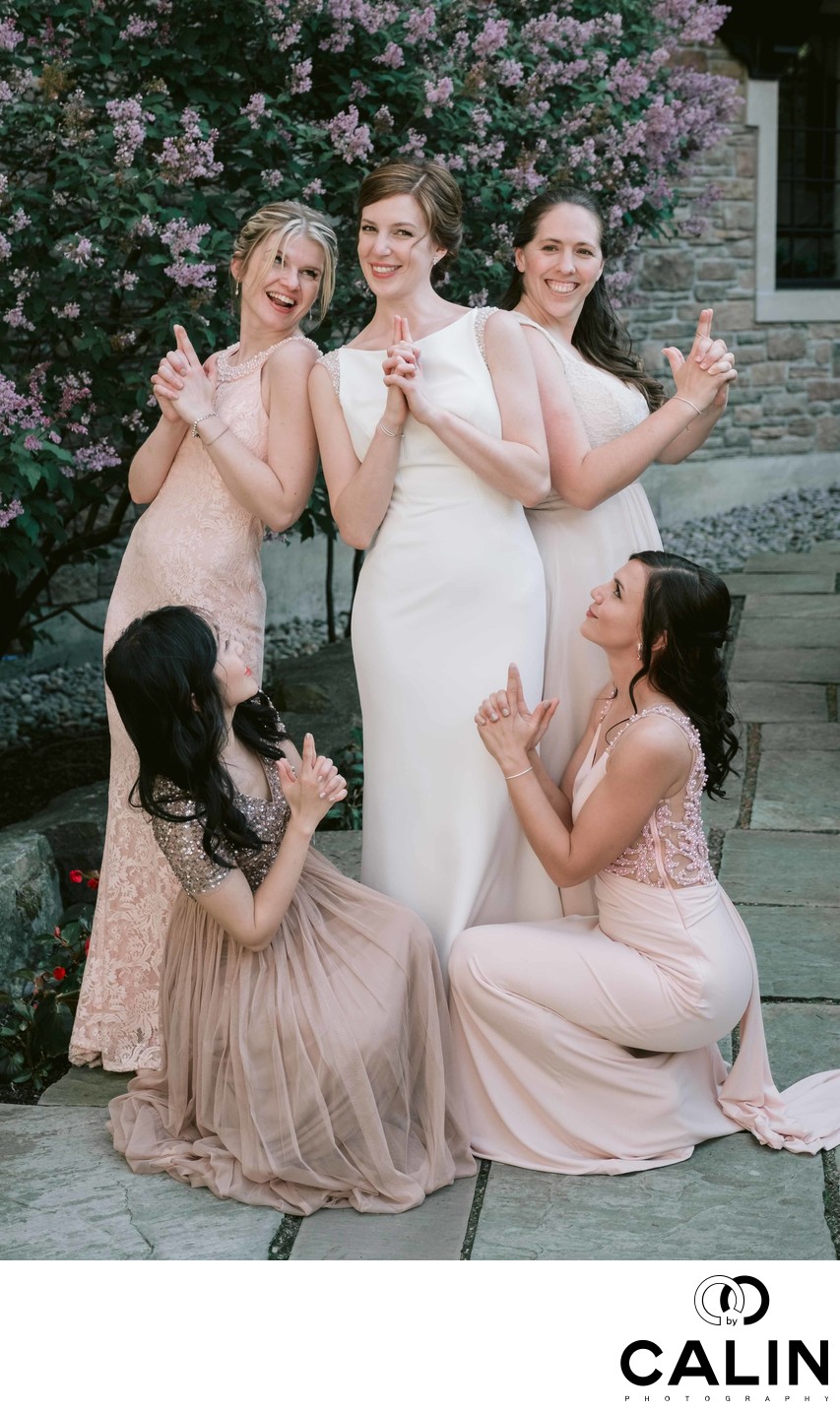
I’ve photographed a lot of weddings, but there’s a particular kind of moment that always tells me we’re about to make something special: the instant the bridal party forgets I’m “the photographer” and starts treating the camera like it’s part of the fun. This is exactly one of those frames—five women, one stone wall, a burst of lilac behind them, and that playful “Charlie’s Angels” attitude that turns a simple portrait into a memory you can feel.
What’s Happening in This Frame (And Why It Matters)
When I look at this image now, I remember how quickly it came together. The bride stands centered in a clean, modern white gown, and the bridesmaids surround her in soft blush and champagne tones—some lace, some shimmer, all coordinated without looking identical. Two are kneeling in front, two are standing slightly behind, and everyone is aimed inward toward the bride’s moment. The finger-gun pose isn’t random; it’s a shared joke, a burst of personality, and an instant signal to anyone viewing the album: this group showed up for her in every way.
The setting does a lot of quiet work here: a textured stone wall, a stone pathway, and that lilac bush blooming in purple behind them. It’s the kind of backdrop that feels timeless and distinctly Old Mill—classic architecture with garden softness—without overpowering the people in the frame. The mood is bright and celebratory, but not chaotic; it’s playful with control, and that balance is what I’m always chasing when I photograph an Old Mill Toronto Wedding.
How I Took It: Context, Timing, and Direction
I created this photo during that narrow window when everyone is dressed, emotions are running high, and the schedule is tight enough that you can’t waste words. I don’t “over-direct” moments like this. Instead, I set one simple framework—where to stand, how to stagger heights, where to put hands—and then I encourage one clear idea: “Give me your version of a movie poster.” That’s it. The bridal party fills in the rest with their own chemistry.
I watch for two things in real time: whether the bride is still the visual anchor, and whether each bridesmaid has a clean line to the camera (no hidden faces, no awkward overlaps). Once those are locked in, I let the expressions run free. The smiles in this frame aren’t polite; they’re genuine, mid-laugh, and slightly competitive—in the best way—like everyone is trying to outdo each other while still hyping the bride up.
Camera, Lens, and Why I Chose Them
I shot this on a pair of Canon R5 camera bodies, and I leaned on Canon RF L-series glass to keep the image crisp, contrasty, and consistent across quick variations. In a moment like this, I want fast, accurate autofocus on faces, clean color, and files that hold up beautifully in post—especially with delicate tones like blush dresses and purple florals.
For this specific look—soft separation, flattering perspective, and a background that stays recognizable without turning busy—I used a Canon RF 70-200mm f/2.8L IS. That lens gives me compression that makes the group feel close and connected, while still letting the lilacs and stone texture read as “place.” It’s also a confidence lens: it renders skin cleanly, it handles highlights gracefully, and it stays sharp even when I’m shooting quickly.
Technique Breakdown: Lighting, Composition, and Depth
The lighting here is natural, and that matters. I positioned them so the light stays flattering across faces—no harsh shadows cutting eyes in half, no blown highlights on the bride’s dress. With a white gown at the center, exposure discipline is everything. I expose to protect detail in the dress first, then lift the shadows on faces in post if needed. The result is a bright frame that still holds texture where it counts.
Composition-wise, the triangle structure is the secret weapon: kneeling bridesmaids create a stable base, standing bridesmaids create height, and the bride is centered as the apex. The lilac blooms act like a color halo behind the group—purple against blush and white—so the palette feels intentional instead of accidental. The stone wall provides clean negative space and keeps the image from feeling “too garden-y.” It’s balanced: soft on one side, structured on the other.
Depth of field is doing emotional work too. I keep the faces tack sharp, but I allow the background to fall slightly out of focus so the viewer’s attention lands exactly where the story is: on the expressions and the relationship dynamics. This is group portraiture, but it reads like a moment.
Why This Is a Great Wedding Photograph (Unequivocally)
This is a great wedding photograph because it has clear emotional truth. The energy is not manufactured. You can see friendship and loyalty in the body language—the way they cluster, the way they angle toward the center, the way the bride’s smile matches theirs instead of fighting it. If you stripped away the dresses and the venue, the feeling would still land.
It’s also great because the technical execution supports the emotion instead of competing with it. The exposure is controlled (white dress detail preserved), the color palette is coherent (blush, champagne, purple, stone), and the composition has structure while still feeling spontaneous. There’s separation between subjects, no distracting overlaps, and the background adds context without stealing attention. In wedding photography, “fun” can easily become messy; this image proves fun can be clean, flattering, and timeless.
My Post-Processing Workflow (Detailed and Practical)
In post, my goal is always the same: keep skin natural, keep the bride’s dress detailed, and keep colors believable while still vibrant. For this frame, I started with a clean, consistent baseline: correct white balance so the stone reads neutral (not yellow/green), then balanced overall exposure to protect highlights on the gown.
Next came targeted color work. I refined the blush/champagne dresses so they stay soft and flattering without drifting orange, and I made sure the lilacs stay purple rather than shifting magenta. I used gentle HSL adjustments (especially in magenta/purple and orange ranges), then subtle luminance control so the flowers brighten without becoming neon.
For skin, I used light-handed retouching: reducing temporary redness, smoothing only where needed (never plastic), and keeping texture intact. I also evened out small exposure differences between faces so the group reads cohesive. Then I applied selective sharpening on eyes and faces, leaving the background softer to reinforce subject separation.
Finally, I shaped the frame: a modest vignette to hold attention in the center, micro-contrast on the stone for depth (without making it gritty), and careful highlight recovery on the dress so it stays luminous but detailed. The finished result feels bright, clean, and energetic—exactly how the moment felt when I pressed the shutter.
Explore More from This Old Mill Toronto Wedding
If you love the mix of classic architecture and playful bridal party energy, you’ll want to see the full set from this venue: Old Mill Toronto Wedding gallery. If you’re specifically here for the laughter and the “we’re doing this our way” portraits, don’t miss: fun bridal party photos at Old Mill Toronto. And for details that tie the whole story together, take a look at: wedding shoes and bouquets.