
Old Mill Toronto Wedding: The Groomsmen Portrait That Set the Tone for the Whole Day
I’ve photographed a lot of wedding parties, but every so often there’s a moment where the energy clicks so perfectly that I can feel the final frame before I even raise the camera. This was one of those moments—five sharply dressed guys, a Tudor-style backdrop, spring lilacs in full color, and that unmistakable “we’re ready” confidence that only happens at an Old Mill Toronto Wedding.
How This Portrait Happened (And Why It Worked Immediately)
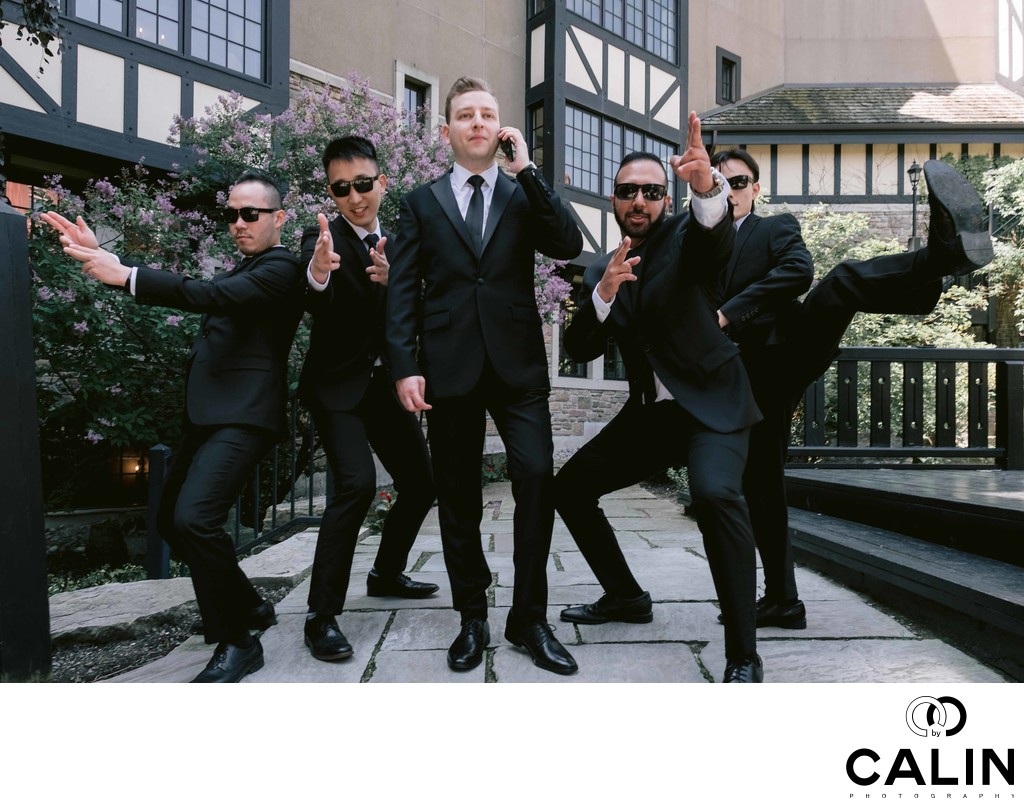
The groomsmen had been moving fast all afternoon—buttoning jackets, checking ties, and doing that half-joking, half-serious banter that keeps nerves in check. When we stepped outside, I saw the setting give us instant production value: patterned stone underfoot, greenery framing the scene, and the Old Mill’s signature architecture sitting behind them like a built-in movie set. They weren’t asking for a stiff lineup. They wanted something that felt like them.
I gave them a simple prompt: “Give me a confident stance, then make it ridiculous.” That’s it. The groom brought the phone up to his ear like he was getting mission instructions, and the rest leaned into the joke—finger-guns, staggered positions, playful intensity. The best part is that the pose wasn’t random; it was organized chaos. Everyone had a role in the frame, and the humor read instantly, even from across the courtyard.
If you’ve ever planned portraits at an Old Mill Toronto Wedding, you know the location rewards quick decision-making. The backgrounds are beautiful, but the light shifts quickly between open sun and shade. I chose a spot where the building texture would show, the florals would pop, and the guys could move without feeling “posed.” The result is a portrait that feels like a scene, not a setup.
What You’re Actually Seeing in the Frame
In the final image, there are five men in matching black suits and ties. Their stance is deliberately cinematic: the central figure anchors the composition while the others create diagonal energy lines, pushing the viewer’s eye back toward the center. The lilac bushes add a saturated purple accent that breaks up the neutrals, and the Tudor-style Old Mill facade gives the portrait context and place—this could not be “any venue.” This looks like Old Mill.
The light is natural and clean, with soft-edged shadows that suggest open shade or filtered sun. That matters because it keeps skin tones even and lets the suit texture stay rich without turning into a black void. It also keeps the mood bright—this image is playful, but it’s not slapstick. It’s confident fun.
Gear Choice: The Canon RF System and the RF L-Series Lens That Nailed It
For a portrait like this, I need speed, reliable autofocus, and crisp micro-contrast—especially with dark suits against a detailed background. I shot this on a Canon RF camera body paired with a Canon RF L-series lens (RF mount). My goal was to keep the group tack-sharp while still giving the background enough separation to feel dimensional, not flat.
When I’m photographing groomsmen outdoors at an Old Mill Toronto Wedding, I typically reach for an RF L zoom in the mid-range because it lets me fine-tune perspective quickly. I can step in for energy, step back for environment, and keep distortion under control. With five subjects, I also need consistent edge-to-edge performance so the guys on the ends don’t soften or warp.
Photographic Techniques: Composition, Depth of Field, and Timing
Compositionally, I treated this like a movie poster. The central figure is the “lead,” and the supporting characters frame him with asymmetry that still feels balanced. The staggered spacing creates depth, and the finger-gun gestures form directional cues that pull attention back into the group instead of letting the eye drift off frame.
Depth of field was chosen to keep all faces sharp while gently separating them from the background. With group portraits, the mistake I see most often is chasing too much blur and losing the back row. Here, I prioritized cohesion: every expression matters, so every face needs to hold detail.
The biggest technique, though, was timing. I didn’t machine-gun the shutter and hope. I watched for the micro-moment when the pose locked in—when the central phone gesture felt intentional and the surrounding “action” looked synchronized. That’s the difference between a goofy pose and a great photograph.
Why This Is a Great Wedding Photograph (No Hedging)
This is a great wedding photograph because it does two difficult things at once: it delivers personality and it delivers polish. The image is funny, but it’s not sloppy. The suits look sharp, the background is clearly Old Mill, and the framing is decisive. Nothing feels accidental.
Emotionally, it works because it’s honest. Wedding party photos can easily turn into “something we had to do.” This looks like something they wanted to do. You can feel the friendship in the willingness to commit to the bit. The groom doesn’t look like he’s being dragged through a checklist—he looks supported, hyped up, and fully present.
Technically, it’s great because the exposure holds detail in black suits, the color has life without looking artificial, and the background context is strong without stealing the scene. The Old Mill architecture is a character here, but it stays in its lane.
Post-Processing: Exactly How I Finished This Image
My editing approach for an Old Mill Toronto Wedding is grounded in clean color, natural skin, and texture preservation—especially important with dark suits and bright florals. Here’s what I did in post to bring this frame to its final form:
First, I set a neutral, consistent white balance and refined it so skin tones stayed believable while still keeping the greenery and lilacs vibrant. Then I established a gentle contrast curve to add dimension without crushing shadow detail in the jackets. I paid special attention to the black point: too low and the suits turn into featureless blocks; too high and the image looks washed.
Next came targeted color work. I lightly controlled greens so foliage didn’t overpower faces, and I protected the purple tones so the lilacs stayed rich rather than shifting neon. I also used subtle luminance adjustments to keep the building’s light walls from pulling focus away from the subjects.
On the subject side, I applied restrained skin smoothing—never plastic, never blurred—just enough to reduce temporary redness while retaining pore-level detail. I sharpened with a mask so edges on suits, ties, and hair gained crispness while flat areas stayed clean. Finally, I used a soft, realistic vignette to keep attention centered, and I performed small, invisible cleanup: distracting bright specks in the walkway, tiny background interruptions, and micro-adjustments to ensure faces were the first read.
How This Moment Fit Into the Full Wedding Story
This portrait wasn’t a throwaway. It set the tempo for the day. Once the guys realized they could be themselves and still look incredible in the photos, everything loosened up—in the best way. Portraits moved faster, expressions got more real, and the groom walked into the rest of the schedule looking lighter.
That’s what I’m always aiming for at an Old Mill Toronto Wedding: images that look refined, but feel human. The location gives you classic atmosphere; the people bring the spark. My job is to shape that spark into photographs that still hit years later.