
Old Mill Toronto Wedding: The Quiet Moment I Chase at Every Wedding
There are photographs that look beautiful, and then there are photographs that feel like proof. Proof that the day mattered. Proof that people showed up for each other. At this Old Mill Toronto Wedding, I watched the room shift in real time—one second it was pre-ceremony chatter, the next it was a private, grounding moment between a groom and his grandmother that changed the emotional temperature of everything around them.
The Scene Before the Aisle: Why This Moment Happened
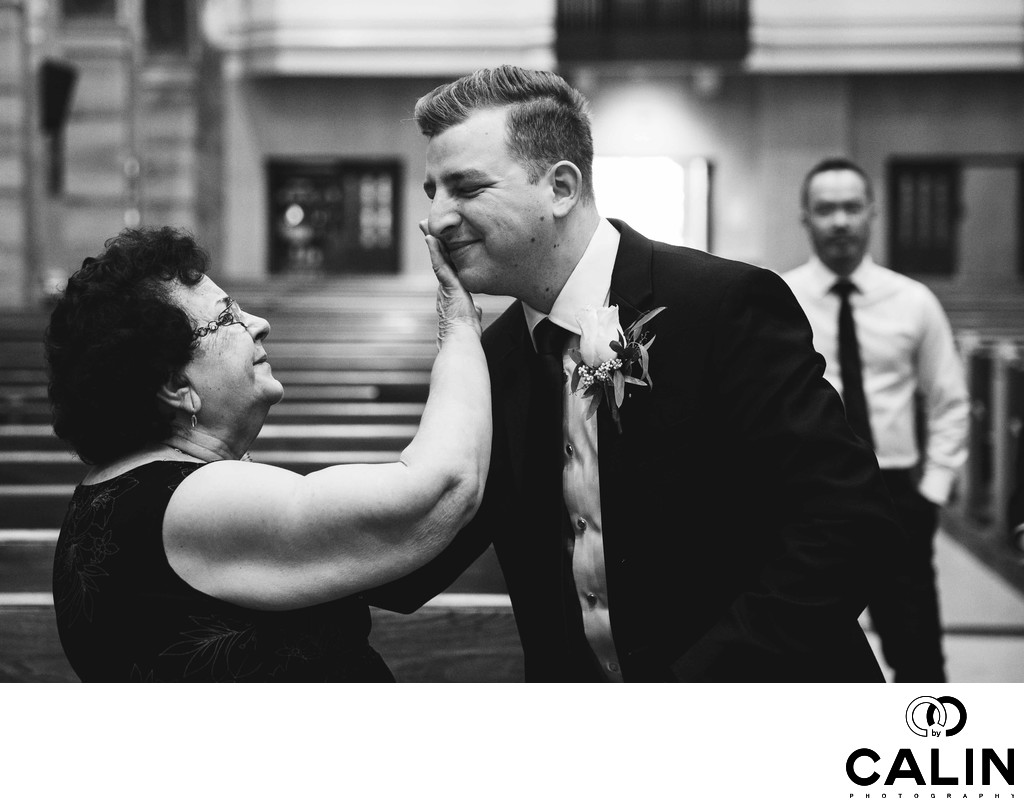
I was already scanning for the story beats that always unfold at the Old Mill: small clusters of family, last-minute adjustments, the calm-before-the-storm energy that lives in historic venues. The groom stood near the pews in a dark suit, boutonniere pinned, shoulders slightly tight—his posture giving away what he was trying not to show. Then his grandmother stepped in close, lifted her hand, and touched his face with the kind of tenderness you only see when someone has earned the right to do it.
He didn’t perform the emotion. He didn’t “pose” it. He let it happen. And when his eyes welled up, she didn’t rush or fuss—she simply stayed present, like she had done a thousand times in his life, steadying him without needing words. That’s the moment I photographed: not a gesture for the camera, but a gesture that would have happened even if I wasn’t there.
What You’re Actually Seeing in the Photograph
The frame is a candid interaction between two people, anchored by touch and eye contact. The background falls away into softness—wooden pews and the architecture of the ceremony space are still recognizable, but they don’t compete. The groom’s suit reads as timeless, and the grandmother’s patterned dress adds texture and visual warmth.
I chose to present the image in black and white because the emotional content is the headline. Color can be beautiful at an Old Mill Toronto Wedding, but monochrome removes every distraction and forces the viewer to look at the expressions, the hand placement, the pause in time. That simplification is deliberate, and it’s why the photograph reads as intimate instead of busy. Old Mill Toronto Wedding
How I Shot It (Gear + Lens Choice)
I photographed this wedding using Canon R5 cameras and Canon RF L-series lenses. For a moment like this—two people close, emotion moving quickly, and no room to interrupt—I work with fast, accurate autofocus and lenses that can separate subjects from the background without turning the scene into a gimmick.
If you’re wondering what lens created this look: the perspective and the gentle compression suggest a short-telephoto approach rather than a wide angle. I often reach for an RF L lens in that range because it lets me keep respectful distance while still capturing micro-expressions—those tiny shifts around the eyes and mouth that tell the real story.
Techniques I Used: Composition, Light, and Depth
The core technique here is restraint. I didn’t “build” this moment with posing; I protected it by staying quiet and positioning myself where I could see faces without hovering. I framed them centrally to keep the relationship as the subject, then used a shallow depth of field so the venue context supports the story without pulling attention away from it.
The lighting reads as soft and natural—likely window light filling the space rather than hard directional flash. That’s important: harsh flash can turn a tender exchange into something clinical. Here, the light is gentle enough to keep skin tones (and in black and white, skin luminance) smooth and flattering, while still maintaining contrast and shape. The result is dimensional without being dramatic for drama’s sake.
Why This Is a Great Wedding Photograph (My Unfiltered Critique)
This is a great wedding photograph because it does what wedding photography is supposed to do: it preserves relationships, not just outfits.
Emotionally, the image lands because it shows two generations meeting each other in a single touch. The groom’s expression is open—unguarded—while the grandmother’s face carries pride and care. The viewer immediately understands what the moment means without needing context or captions.
Technically, it works because nothing is fighting for attention. The focus is where it must be (on the interaction), the background is simplified through depth of field, and the monochrome treatment creates cohesion. The composition gives the subjects space to breathe; the environment frames them, but never steals the scene. That balance—story first, technique serving story—is the standard I’m always trying to hit at an Old Mill Toronto Wedding.
Post-Processing: Exactly How I Finished the Image
My editing approach for moments like this is designed to make the photograph feel honest, clean, and timeless—without sanding off the reality. After culling, I start with a neutral base conversion and then refine intentionally:
1) Monochrome conversion with controlled luminance: I convert to black and white with attention to skin luminance first (so faces don’t go flat or muddy). I adjust the tonal mix to keep separation between suit fabric, skin, and the grandmother’s patterned dress.
2) Contrast shaping (not “crushing”): I add midtone contrast to define facial structure, but I protect highlights so the image keeps a soft, film-like roll-off. The goal is dimension, not harshness.
3) Local dodging and burning: I subtly dodge the eyes and key facial planes to guide attention, and I burn the edges and background hotspots to keep the viewer inside the moment. This is how I “compose twice”—once in camera, once in post—without making it look edited.
4) Background management: I reduce distracting brightness in the pews/architecture so the venue stays present but quiet. If there are any minor visual interruptions (tiny bright points), I clean them carefully so nothing pulls the eye away from the connection.
5) Texture and sharpening: I apply conservative sharpening to faces and key fabric details (like lapels), while keeping skin texture natural. Over-sharpening emotional candids makes them feel brittle; I avoid that entirely.
6) Grain (if used): If I add grain, it’s subtle and consistent—more for cohesion than effect—helping the monochrome feel organic rather than sterile.
How This Moment Connects to the Rest of the Day
Moments like this don’t exist in isolation—they set the tone. After photographing this exchange, I watched the groom reset his breath and posture, like someone had quietly reminded him what the day was really about. Later, that emotional thread continued in the getting-ready energy and the first time he saw his bride. If you want to see how the story built around this moment, these two frames connect naturally: bridesmaids helping the bride get dressed at Old Mill and the groom seeing the bride at the Old Mill.