
Old Mill Toronto Wedding: The Split Second That Changed the Room
I’ve photographed a lot of weddings, but there are certain frames I can still feel in my hands—the weight of the camera, the micro-adjustment of focus, the quiet breath I took before pressing the shutter. This image is one of those. It happened during an Old Mill Toronto Wedding ceremony, in that charged moment when the aisle stops being “an aisle” and becomes a threshold.
What I Saw Before I Raised the Camera
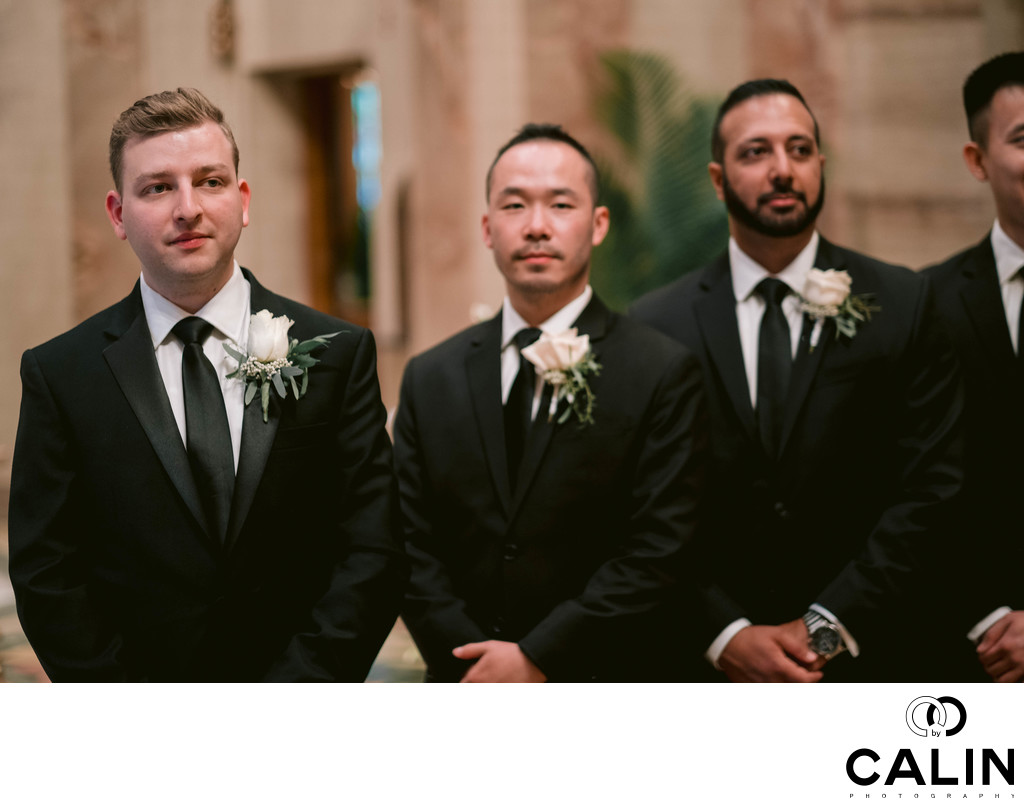
Just before the processional reached the point where everyone turns their heads, I watched the front of the room. Not the décor, not the officiant, not the planned symmetry—just the people who couldn’t fake what they were feeling. The groom and his closest friends were lined up in formal black suits, white shirts, black ties, each with a crisp white boutonniere pinned to the left lapel. Their posture said “we’re ready,” but their faces said something more honest: “this is real.”
The Old Mill’s interior light has a particular character—warm, gentle, and slightly directional—like it’s been filtered through history. It doesn’t behave like a modern hotel ballroom. It wraps. It softens. It makes skin tones look alive. I knew immediately I didn’t want to overpower that with flash. I wanted to preserve the feeling of the room as it actually was.
How I Made This Photograph (Context + Camera Choices)
This frame was created as the groom registered what was happening behind me—the bride approaching—and his expression shifted from composed to openly present. My goal was to photograph reaction without turning it into a performance. I positioned myself slightly off-axis so I could hold the groomsmen in a tight cluster while letting the background fall away into a soft blur.
I shot this on a Canon R5 using Canon RF L-series glass. For moments like this, I rely on an RF L lens that gives me three things at once: fast autofocus, strong subject separation, and flattering compression that keeps faces natural. In practice, that means a mid-to-telephoto perspective and a wide aperture—not to “make it artsy,” but to remove visual distractions so the viewer’s attention goes exactly where the emotion is.
Because this was a ceremony environment with consistent warm ambient light, I kept my approach clean: stable shutter speed to freeze micro-expressions, aperture open enough to separate, and ISO set to protect highlight detail in shirts and boutonnieres. The Canon R5’s files hold up beautifully when you expose with intention, and that matters when the most important thing in the frame is subtle tonal transitions in faces, not dramatic lighting tricks.
What’s Actually Happening in the Frame
You’re looking at a tight grouping of groomsmen at the front of the ceremony. The image is about anticipation—men who have been “fine” all morning suddenly realizing they’re witnesses to a once-only moment. Their suits read formal and consistent, but their expressions are individual. That’s what I’m always hunting: uniformity in styling, individuality in feeling.
The background elements—soft architecture and a hint of greenery—confirm the setting without competing with it. The shallow depth of field is deliberate: it turns the venue into atmosphere rather than information. The warmth in the color palette reinforces the emotional tone. Nothing feels cold or clinical. The scene feels lived-in, immediate, human.
Composition and Technique (Why It Reads as Cinematic Without Trying)
I built this composition around a simple principle: clustered faces + clean lines. The groomsmen’s shoulders and lapels create subtle diagonals that guide your eyes upward into expression. The boutonnieres add bright anchor points—small, controlled highlights that keep the frame from feeling heavy despite the dark suits.
The shallow depth of field does more than blur the background; it compresses the scene emotionally. When the background fades, the viewer experiences the moment the way the groom experiences it—tunnel vision, clarity, pressure, focus. That’s not an accident. That’s the visual language of a ceremony moment done right.
Light-wise, I stayed with available light to keep the mood intact. The softness suggests bounced or diffused ambient illumination—exactly the kind of environment where the Old Mill shines. I didn’t want a “photographed” look; I wanted a truthful look.
My Professional Critique: Why This Is a Great Wedding Photograph
This is a great wedding photograph because it delivers emotion with restraint. The moment isn’t forced. Nobody is “doing something for the camera.” The image respects the ceremony by staying observational, and that’s why it hits.
Technically, it succeeds because the choices serve the story. The exposure protects detail in high-contrast areas (white shirts, boutonniere petals) while keeping the blacks of the suits rich instead of muddy. Focus is confident—faces are sharp where they need to be, and the background blur is smooth, not busy. The color temperature is warm but not orange, which keeps skin looking natural. The framing is tight enough to feel intimate, yet spacious enough to keep it from feeling cramped.
Most importantly, the image carries a social truth: a wedding isn’t only about the couple; it’s about the people holding them up. That’s what this frame preserves—community, nerves, pride, and the sudden realization that the day has officially begun.
Post-Processing: How I Finished the Image (In Detail)
My edit was designed to keep the scene believable while making the emotional center unmistakable. The workflow, in broad strokes, looks like this:
1) Color management and white balance: I neutralized any mixed-light contamination while preserving the Old Mill’s warm character. The goal is warmth in the midtones without pushing highlights into yellow. Skin tones were the priority; everything else follows.
2) Contrast shaping (not just “adding contrast”): I used a gentle S-curve to create separation between suits and background while keeping the roll-off in highlights smooth. I avoid harsh micro-contrast on faces during ceremonies; it can turn honest expressions into something gritty.
3) HSL refinement: I tamed overly saturated warm channels so boutonniere whites stayed clean and shirts didn’t pick up a color cast. Greens in the background were kept subdued to avoid pulling attention away from faces.
4) Local adjustments: Subtle dodging on faces to guide the eye; minimal burning on the brightest shirt areas to keep them from dominating. I also used targeted clarity/texture adjustments—slightly reduced on skin, slightly increased on suit fabric and boutonnieres—to keep the frame polished without looking “processed.”
5) Noise control and sharpening: Noise reduction was applied conservatively to protect fine detail. Sharpening was focused on facial features with masking, so background blur remained smooth and natural.
6) Crop and edge discipline: I refined the edges to remove any tiny distractions and keep the viewer inside the emotional triangle of the group. If the eye can escape the frame too easily, the moment feels smaller than it was.
How This Moment Connects to the Full Old Mill Story
If you’re planning an Old Mill Toronto Wedding, this is the kind of moment worth protecting in your timeline: the pause before the ceremony accelerates. The Old Mill offers an environment where reactions feel amplified—warm interiors, intimate spacing, and a sense of tradition that makes people drop their guard.
To see more of this wedding day in sequence, view the full gallery: Old Mill Toronto Wedding gallery.
Two other parts of the day that complete the emotional arc are the groom’s connection with family and the bride’s entrance. They’re different beats, but they’re the same story told from different angles: groom and grandmother moment at the Old Mill Toronto wedding and bride walks the aisle at the Old Mill wedding.