
Old Mill Toronto Wedding — Groom Details, Shot With Intention
When I photograph an Old Mill Toronto Wedding, I’m always watching for the quiet evidence of who the couple is—before the ceremony begins, before anyone is fully dressed, before the schedule gets loud. This frame was made in that in-between time: the groom’s room, a coffee table, and a handful of objects that say more than a full-length portrait ever could.
What I Saw First (And Why I Didn’t Touch a Thing)
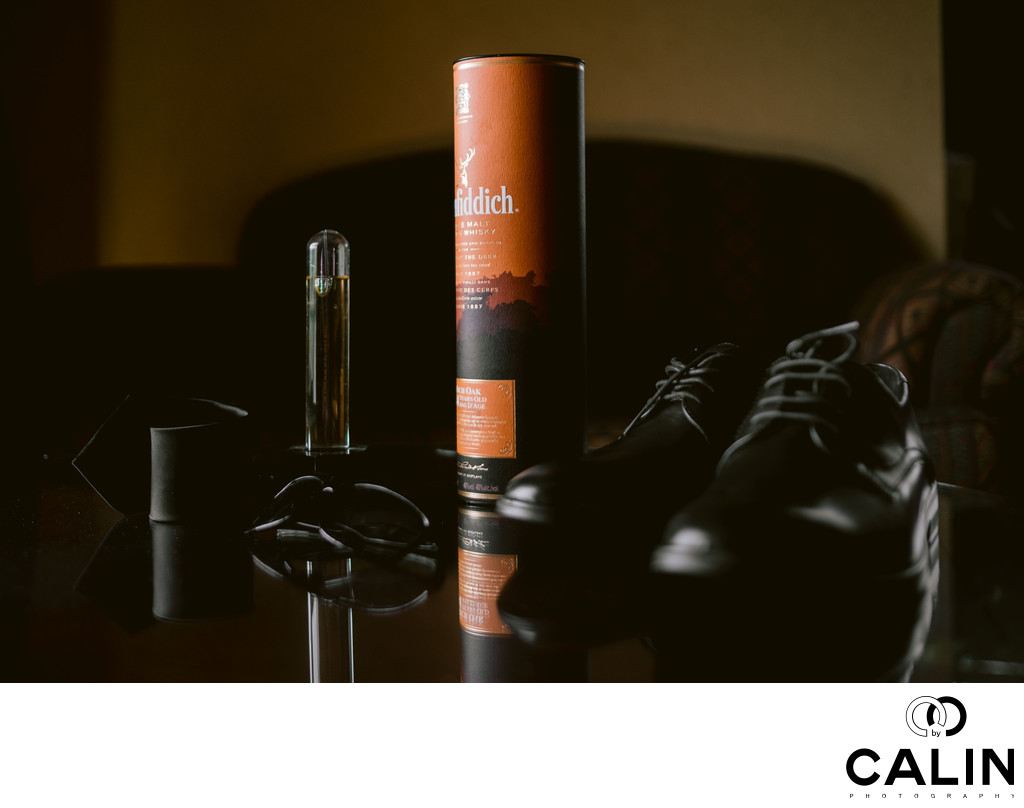
I walked into the suite and immediately clocked the reflective tabletop—dark, glossy, and clean enough to behave like a built-in mirror. The groom’s essentials were already there, not staged by me: a cylindrical Glenfiddich presentation tube standing tall, a cologne bottle with amber liquid, a rolled black tie, round metal-framed sunglasses, and a pair of polished black leather dress shoes sitting just beyond the sharpest plane of focus. The reflections were subtle but present, doubling the storytelling without doubling the clutter.
That’s why I didn’t rearrange anything. The point of groom details, at least the way I shoot them, isn’t to create a catalog image. It’s to preserve the atmosphere of the morning as it actually looked—elegant, a bit restrained, and confident. In an Old Mill setting—where the venue itself already carries a sense of heritage—authenticity reads as luxury.
The Context: A Groom Who Prepared Like He Meant It
This image was made during the final stretch of getting ready, when the groom had moved from “hanging out with the guys” into “time to become the groom.” I remember the room’s sound: soft conversation off to the side, a couple of quick laughs, then that calm pause that happens when someone takes a breath and realizes the day has arrived. The details on the table weren’t random; they were a checklist of personal standards—scent, style, a drink chosen with care, shoes that had clearly been polished with intention.
Detail photos like this become emotional later because they’re honest. When the couple looks back, they don’t just see objects—they remember the pace of the morning, the smell of cologne in the air, the weight of the tie in hand, the first sip poured to steady the nerves. That is exactly what I want from a groom-details frame at an Old Mill Toronto Wedding: proof of the moment, without theatrics.
How I Shot It: Canon RF Camera + Canon RF L Lens Choices
For this photograph, I shot on a Canon RF-series camera paired with a Canon RF L-series lens. In practice, this is the kind of frame I most often build with an RF 50mm f/1.2L when I want richness in texture and a controlled falloff, or an RF 35mm f/1.4L when I want a slightly wider story without distortion. Here, the depth separation is deliberate: the Glenfiddich tube and nearby items hold attention, while the shoes soften just enough to feel present but not competing.
I shot from a slightly elevated angle—high enough to read the arrangement clearly, but not so overhead that the objects become flat shapes. The table’s reflective surface is doing real work, so my angle mattered: tilt too far and reflections dominate; stay too low and the scene loses clarity. I aimed for that middle ground where the reflections feel like atmosphere, not a gimmick.
Lighting, Composition, and Depth of Field (The Real Mechanics)
The light is soft and directional—most consistent with window light or heavily diffused room light—creating gentle transitions and keeping specular highlights under control. That matters on black leather shoes and glass: hard light would have blown the reflections and made the frame look harsh. Instead, the highlights are smooth, which preserves a premium feel.
Compositionally, the vertical cylinder (the Glenfiddich tube) acts as the anchor. The tie creates a low horizontal sweep that keeps the scene grounded. The cologne bottle adds a second, shorter vertical element so the frame doesn’t rely on a single “tower.” Sunglasses add a circular shape to break up all the rectangles and cylinders. The shoes—positioned near the right side—give the image a visual “full stop,” even though they’re slightly out of focus. The negative space is controlled; nothing feels crowded, and nothing feels missing.
Depth of field is shallow enough to separate subjects from the background furniture, but not so shallow that the story collapses into a single sharp label. That balance is what makes detail photography feel editorial rather than accidental.
Why This Is a Great Wedding Photograph (Unequivocally)
This is a great wedding photograph because it delivers both emotional clarity and technical discipline in the same frame.
Emotionally, it functions as a character portrait without showing a face. The groom comes through as precise, classic, and grounded. The whiskey choice suggests celebration on his terms. The cologne signals care and presence. The polished shoes and neatly rolled tie tell me he wasn’t rushing—he was preparing. This isn’t “stuff on a table.” It’s the groom’s mindset, translated into objects.
Technically, it’s controlled: the highlights on glass aren’t blown, the blacks hold texture, the reflections add depth without turning into chaos, and the focus plane is placed with intention. The frame doesn’t feel over-styled; it feels observed. That combination—observational honesty with professional execution—is exactly what separates a good detail shot from a portfolio-level one. This is the kind of image that strengthens the entire narrative of an Old Mill Toronto Wedding because it creates pacing: a quiet beat before the ceremony’s momentum takes over.
My Post-Processing Workflow (What I Actually Did and Why)
I processed this image with a “clean editorial” goal: natural warmth, true blacks, readable labels, and texture that looks tactile—not crunchy.
1) RAW Conversion and Global Tone
I started with a neutral profile and set my white balance to preserve the warm amber in the cologne and the whisky tones without pushing the blacks toward muddy brown. I brought highlights down to protect the reflective tabletop and glass edges, then lifted shadows carefully—just enough to reveal detail in the tie and shoe leather without flattening contrast.
2) Contrast Shaping (Not a Heavy Hand)
I used a gentle S-curve to add midtone separation while keeping the roll-off smooth in the highlights. The goal was to keep the image dimensional, not “HDR.” Blacks were anchored so the scene stayed masculine and refined, but I avoided crushing—texture in black objects is part of the luxury signal.
3) Color Work (HSL + Targeted Control)
I refined oranges/yellows to keep the warmth elegant rather than orange. I kept greens restrained so any brand color remains believable and doesn’t pull attention away from the overall mood. Saturation was guided by restraint: enough to feel rich, not enough to feel loud.
4) Local Adjustments: Dodge & Burn With Purpose
I dodged the key edges where I wanted the viewer’s eye to travel—label transitions, the rim of the cologne bottle, and select leather highlights. I burned the outer edges subtly to hold attention inside the arrangement. This was not a “vignette effect”; it was hand-shaped light guidance.
5) Texture and Sharpening (Selective, Not Global)
I applied sharpening primarily to the focal subjects and let the background stay creamy. I enhanced micro-texture where it matters—leather grain, label crispness, glass definition—while avoiding clarity on the entire frame (global clarity would make reflections harsh and exaggerate noise in darker zones).
6) Cleanup and Consistency
I removed tiny distractions that don’t belong in a final wedding narrative (minor dust specs on reflective surfaces, micro blemishes in highlights) while leaving real-world texture intact. The point is polish, not plastic.
How This Frame Fits the Full Old Mill Story
On a wedding day at the Old Mill, I’m always building a sequence: details, preparation, people, emotion, architecture, then celebration. This groom-details photograph is the calm opening note. From here, the story naturally moves into the energy of the guys together—see the fun groomsmen photo at Old Mill Toronto—and then into a strong, confident portrait of the groom once everything is in place—see the handsome groom portrait at Old Mill Toronto.
But I’ll always keep space for images like this, because years later, these are the photographs that bring the day back in full sensory detail: the shine of the shoes, the warmth in the glass, and the quiet certainty right before the ceremony begins.