
Old Mill Toronto Wedding: The “Just Married” Moment I Wait All Day For
I’ve photographed enough weddings to know that the best frames aren’t always the most posed—they’re the ones that happen the second people forget I’m there. At this Old Mill Toronto Wedding, I watched the energy shift right after the ceremony: shoulders dropped, hands found each other without thinking, and the room exhaled. That’s when I made this photograph—the kind of image that doesn’t just show what they looked like, but what it felt like to finally be married.
What’s Happening in the Photo (And Why It Matters)
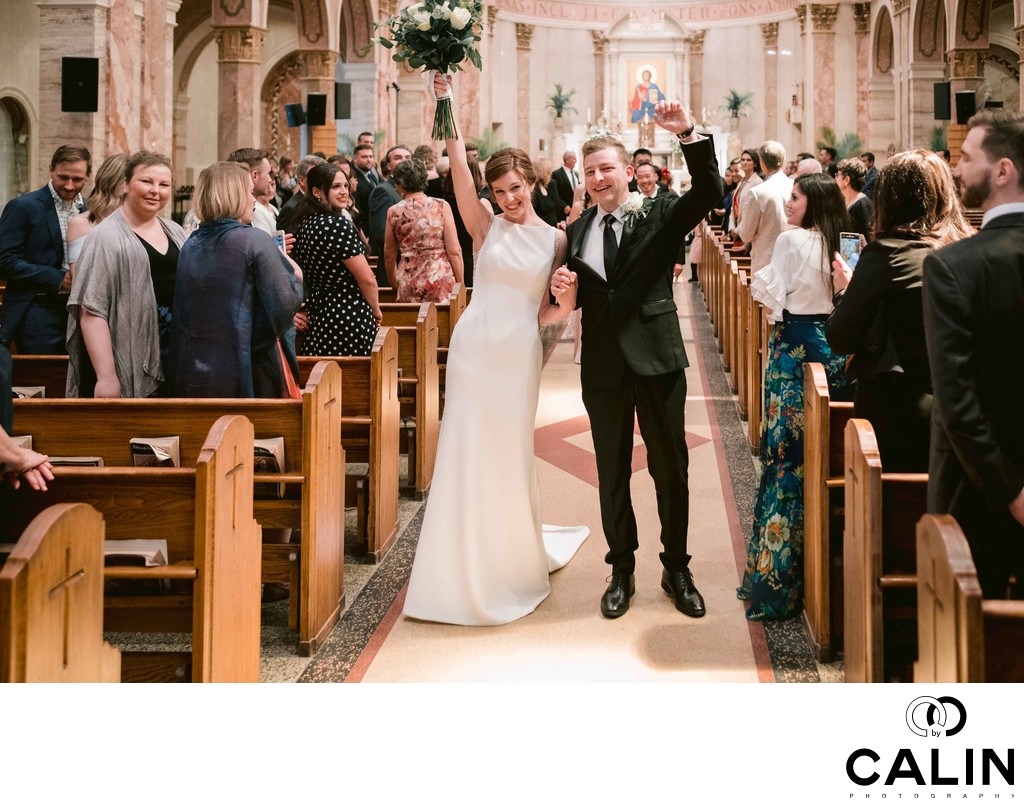
In the frame, the couple is walking forward with that unmistakable “we did it” momentum. The groom’s arm is raised in celebration. The bride lifts her bouquet overhead like a victory flag. Their expressions are pure relief and adrenaline—wide, genuine smiles that don’t need direction. Guests line both sides of the aisle, and the architecture rises behind them in repeating columns and arches, giving the moment a sense of ceremony even as it turns into celebration.
This isn’t a “look at the camera” picture. This is a “look at each other and keep moving” picture. I remember choosing to let the aisle and the symmetry do the heavy lifting, so their body language stayed front and center. When a couple gives you that kind of authentic emotion, the only job left is to not get in the way.
The Context: How I Set Up This Moment Without Staging It
The moment I saw the bouquet tighten in her hand—like she was about to lift it—I adjusted my position to stay square to the aisle and let the scene open up behind them. I’m always watching micro-signals: a breath, a glance, a squeeze of the hand. Right after the signing and the final words, couples often “snap” from formal to real. That transition lasts seconds. I shot through it, not because I was spraying and praying, but because timing matters more than perfection in a moment like this.
At an Old Mill Toronto Wedding, there’s often a beautiful mix of classic surroundings and high emotion, and this frame lives exactly in that intersection: tradition in the background, joy in the foreground. If you’ve ever wondered why photographers care so much about the recessional, it’s because it’s the first time the couple is moving forward together as a unit—with everyone they love witnessing it.
Gear & Lens Choice (Canon R5 + Canon RF L-Series)
I photographed this using Canon R5 cameras and Canon RF-mount L-series lenses. For an aisle recessional like this, my go-to choice is a fast telephoto zoom—most often the Canon RF 70-200mm f/2.8L IS—because it lets me keep a respectful distance while still compressing the scene and isolating emotion. The perspective in this image—tight enough to feel intimate, but wide enough to show the guests and architectural rhythm—fits that lens choice perfectly.
The Canon R5’s autofocus performance is a real advantage here: people are moving toward me, expressions change mid-step, and I need the camera to lock on instantly so I can focus on timing and composition instead of fighting focus.
Photographic Techniques: Lighting, Composition, and Depth
The lighting reads as bright and even—likely a combination of ambient interior light with daylight filtering in—so I exposed to protect highlight detail in the dress while keeping skin tones natural and luminous. In a high-contrast space, I’m watching the whites constantly: bouquet highlights, the gown, reflective surfaces. If I blow those, the image loses refinement immediately.
Compositionally, I leaned into symmetry. The aisle creates a strong leading line that pulls you straight to the couple, while the guests create a human frame on both sides. The columns and arches add repetition and scale—visual cues that say “this is important” without me needing to manufacture anything.
Depth of field is shallow enough to soften the background and keep attention on their faces and gesture, but not so shallow that the setting disappears. That balance is intentional: the location should support the story, not compete with it.
Why This Is a Great Wedding Photograph (Unambiguous Critique)
This is a great wedding photograph because it captures a peak emotion that cannot be faked. The raised arms and open smiles are spontaneous and synchronized in a way you only get when two people are genuinely overwhelmed in the best possible way. If the moment were staged, it would look staged—here, it looks inevitable.
Technically, it succeeds because the exposure is controlled on difficult whites, the framing is clean, and the timing is exact. Their gestures are at full extension, their expressions are at full intensity, and the scene behind them reinforces the significance without distracting from it. The image has a clear subject, a clear emotional read, and a strong visual structure. That combination is what makes a wedding frame hold up years later, long after trends change.
Post-Processing: How I Finished the Image (In Detail)
My post work here is designed to preserve realism while elevating clarity and mood—especially important for an Old Mill Toronto Wedding, where warmth and classic tones can easily tip too yellow or too flat if you’re careless.
First, I corrected the overall white balance to keep the dress neutral while maintaining warm, inviting skin tones. Then I shaped contrast gently with a controlled S-curve: lifting midtones for a lively feel, anchoring blacks so the suit retains depth, and rolling off highlights to keep the gown from looking harsh or crunchy.
Next came selective adjustments: subtle dodge on faces and hands to guide attention, and a mild burn on bright background elements that might pull the eye away. I refined color by reducing any distracting saturation in warm architectural tones while protecting natural reds in skin. Finally, I applied moderate sharpening to the couple (especially eyes and facial contours) and kept background sharpening restrained to maintain separation. Any noise reduction was light and targeted, focused on shadow areas so texture in fabrics stays believable.
The end goal is simple: the image should feel like the day felt—bright, clean, and full of momentum—without looking “processed.”
More from This Old Mill Toronto Wedding
If you want to see how the story flows around this moment—build-up, ceremony, reactions, and portraits—explore the full set here: Old Mill Toronto Wedding photography gallery.
For the emotional peak inside the ceremony, this frame pairs beautifully with: first kiss at Old Mill Toronto Wedding.
And when the pace slows down and we create something timeless and composed, I always return to: bride and groom portrait at Old Mill Toronto.