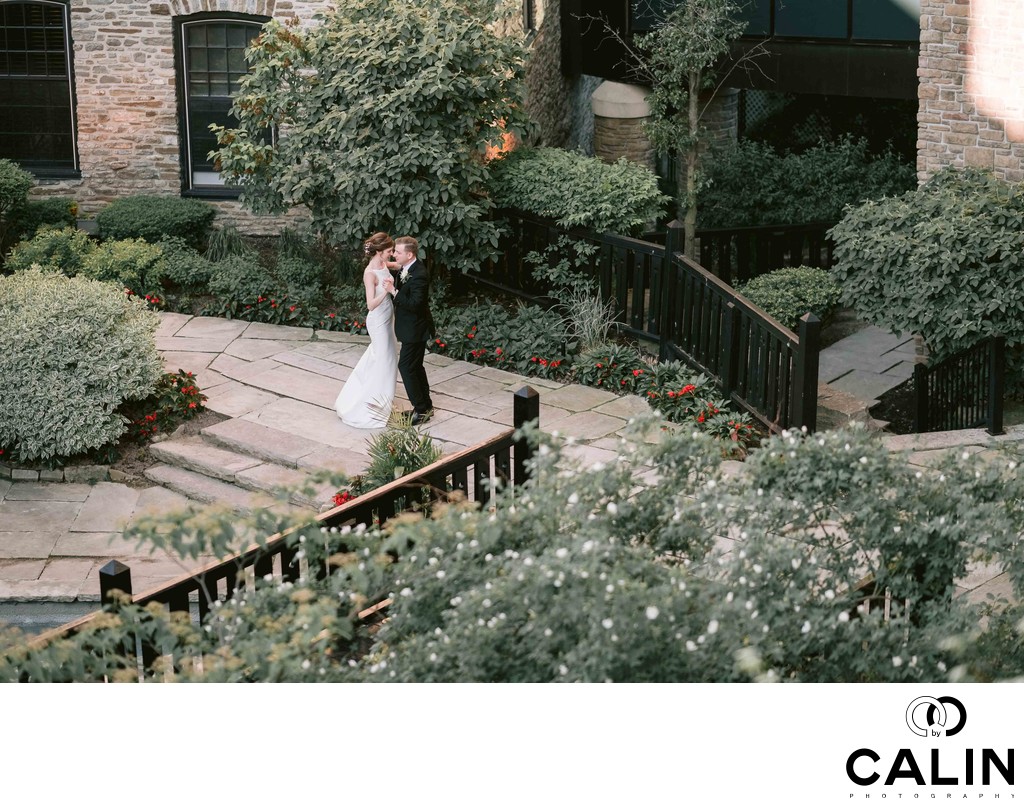

Old Mill Toronto Wedding: The Courtyard Dance
I’ve photographed a lot of weddings, but there’s a particular kind of calm that hits me when I’m outside at the Old Mill as the day starts to soften. The courtyard and garden paths have this quiet, storybook structure—stone underfoot, textured greenery at the edges, and a sense that the place has seen a thousand love stories without ever getting tired of them. On this wedding day, that calm turned into something electric when the two of them stepped into the open and began to dance like nobody else existed.
The Context: How This Courtyard Moment Happened
This moment wasn’t scheduled, and that’s exactly why it matters. We had already moved through the classic beats—portraits, family formals, the steady rhythm of a timeline that never stops ticking. Then the pace changed. They drifted toward the garden walkway, just the two of them, as if the venue itself pulled them outside for air. I saw the shift immediately: shoulders dropping, hands finding each other again, and that subtle exhale couples do when the day finally becomes real.
I didn’t announce myself. I didn’t direct. I simply followed at a respectful distance and let the scene build. When they started to sway—half laughter, half relief—I knew I had the photograph. Not because it was dramatic, but because it was honest. This is the kind of image that ends up meaning more five years later than it did on the wedding day, because it preserves how it felt, not just how it looked.
Technical Breakdown: Gear, Lens Choice, and Why It Fits This Scene
I shot this with my Canon R5, paired with a Canon RF L-series lens (RF mount). For a scene like this—intimate, environmental, and layered with beautiful background texture—I typically live in that “natural perspective” range. In practice, that usually means I’m choosing an RF L lens that lets me work quickly, focus decisively, and render the background with a gentle falloff while still keeping enough context to anchor the couple in place.
Based on the way the environment reads—clear courtyard detail, but the couple remains dominant—I’d approach this with a mid-range focal length (often around 35–50mm on full frame) and a wide aperture to separate them from the garden without turning the background into pure blur. The Canon R5’s files also give me the flexibility to protect highlights and lift shadows cleanly, which matters in outdoor courtyards where stone, foliage, and skin tones can all pull exposure in different directions.
For settings, I’m typically aiming for a shutter speed that keeps the couple crisp even if they sway (often 1/250 or faster), an aperture wide enough for separation (commonly around f/2–f/2.8), and ISO that stays clean while preserving the ambient feel. The goal is simple: make the moment look like it felt—soft, warm, and real—without sacrificing sharpness where it counts.
Composition and Light: The Decisions You Don’t Notice (But You Feel)
Compositionally, this image works because the setting frames the couple without overpowering them. The stone path leads the eye inward, the fence and greenery create natural boundaries, and the building in the background adds weight and context—proof of place, not just pretty scenery. I’m always watching for that balance: enough environment to say “Old Mill,” but not so much that the couple becomes small inside it.
The light here is soft and natural, the kind that makes skin forgiving and greens look alive. It isn’t harsh or contrasty; it wraps. That matters because romance in photography often comes down to transitions—how smoothly highlights roll off, how shadows hold detail, and how the whole scene avoids feeling “lit” in a way that breaks the spell. In a courtyard, I’m also mindful of subtle mixed-light contamination (bounce off stone, reflected green from foliage). I expose and white-balance with that in mind so their skin stays believable.
Depth of field is doing quiet work too: the background is present, but it doesn’t compete. The couple lands as the emotional focal point, and everything else supports them like a well-built set.
Why This Is a Great Wedding Photograph (Unambiguously)
This is a great wedding photograph because it’s emotionally specific. It isn’t a generic “couple in a nice place.” It’s two people choosing each other in the middle of a day that tries to pull them in a hundred directions. Their body language reads as private—close, unperformed, anchored. That’s the difference between a photo that looks good and a photo that matters.
Technically, it’s great because the choices are disciplined. The framing is intentional. The background has narrative value without clutter. The light is flattering without being fake. Focus is where it needs to be, and the exposure holds detail across stone, greenery, and skin—three elements that can easily fight each other if you’re careless. The image feels effortless, and that “effortless” quality is usually the result of doing a lot of things right at the same time.
Post-Processing: How I Finished This Image (In Detail)
My post-processing for a scene like this is about refining reality, not reinventing it. I start with a neutral, consistent baseline: accurate exposure, corrected white balance, and a gentle contrast curve that preserves highlight detail. Courtyard scenes often benefit from controlled highlights (stone can blow out fast) and lifted shadows (foliage can block up), so I’ll shape tonal range carefully rather than pushing global contrast too hard.
Next, I refine color. Greens can turn aggressive if you let them, especially in well-watered garden spaces. I’ll often tame green saturation slightly, adjust green luminance so foliage feels natural, and protect skin tones from picking up a green cast. Skin tone work is always subtle: small HSL adjustments, selective warmth where needed, and keeping reds from oversaturating.
Then I move into local adjustments: a gentle dodge on faces/hands to guide attention, slight burn on bright distractions, and micro-contrast where texture adds value (stone path, architectural elements) without making the couple look overly “crunchy.” Sharpening is controlled—focused on subject detail—paired with mild noise reduction so the file stays clean and organic. Finally, I’ll straighten and crop with intention: I want lines to feel stable, and I want the viewer’s eye to land on the couple without wandering.
The Wedding Story Inside the Frame
When they danced, it wasn’t for the guests. It wasn’t for a playlist cue or an announcement. It was a reset—hands together, a small pocket of time where the day stopped performing and started belonging to them again. I watched the bride’s dress catch the soft light, watched the groom pull her closer with that protective ease that shows up when someone is fully present. I’ve seen couples “do” romance for photos. This wasn’t that. This was a real breath in the middle of everything.
That’s what I love about an Old Mill Toronto Wedding: it gives you these spaces where emotion can unfold without needing decoration. The venue does its job quietly—stone, gardens, heritage texture—so the couple can do theirs loudly: laugh, exhale, hold on.
Explore More from This Old Mill Toronto Wedding
If you want to see more images with the same courtyard-and-garden atmosphere, view the full Old Mill Toronto wedding gallery.
For a different emotional beat—softer, more cinematic—see the moment captured in newlyweds kissing with the veil at Old Mill Toronto.
And for a clean, classic expression of the same connection, visit the newlyweds kiss at Old Mill Toronto.