
Old Mill Toronto Wedding Night Portrait: How I Crafted This Classic, Romantic Staircase Scene
There’s a specific kind of quiet that settles in once the reception is in full motion—music humming inside, laughter bouncing off stone walls, and just enough space outside for two people to remember what the day is actually about. That’s the moment I’m always watching for during an Old Mill Toronto Wedding: the point where the timeline stops feeling like a checklist and starts feeling like a story.
The Moment I Was Waiting For at an Old Mill Toronto WeddingI photographed this portrait after the day had already delivered its big scenes—the formalities, the family photos, the entrances. But the image I wanted was smaller than all of that: a private pause, captured in a place that looks like it was built for candlelit romance.
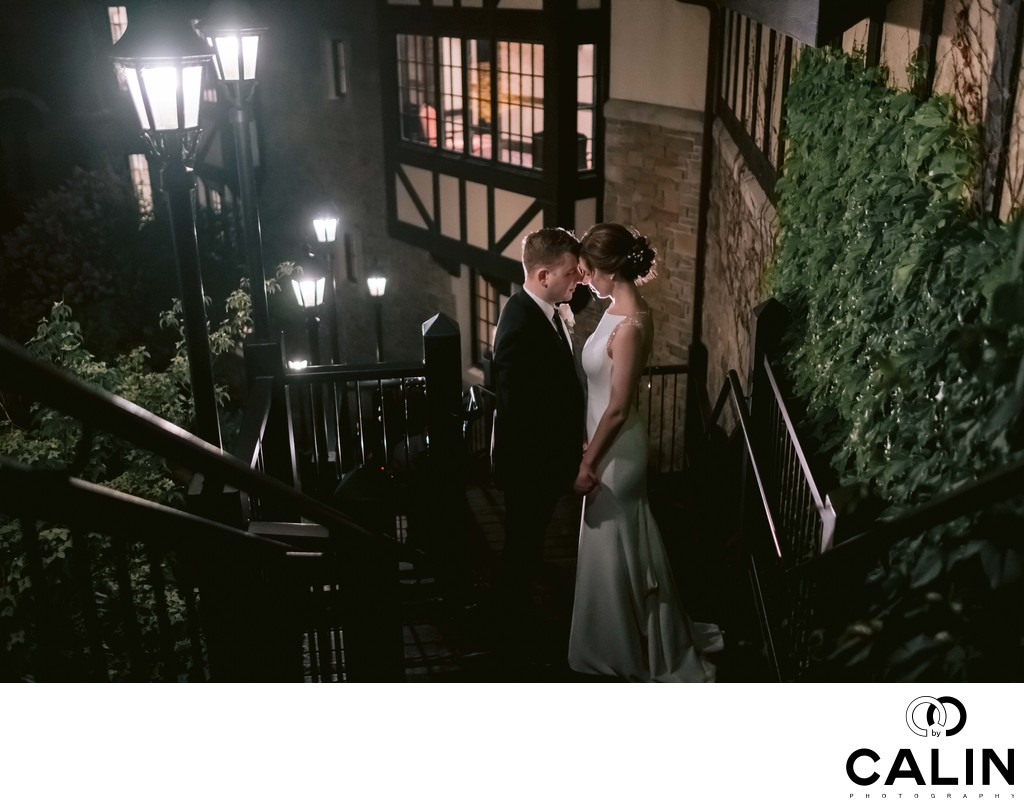
We stepped away to a staircase framed by dark, polished wood railings and climbing greenery. The architecture here has that old-world, Tudor-inspired character, and at night it becomes even more dramatic. The background lamps glow warm and steady, and the deeper shadows add shape and atmosphere without turning the scene into something theatrical. What mattered most was that the couple didn’t “perform” for me—they simply leaned in, foreheads touching, and exhaled.
What You’re Actually Seeing: A Photographer’s Breakdown of the Scene
The couple is positioned mid-staircase, close enough that their posture reads as natural intimacy instead of posing. The bride’s gown catches the available warmth in the environment, while the groom’s black tux anchors the frame and creates a clean, formal contrast. I composed this to let the staircase lines guide your eye upward toward them, while the repeating lamp lights in the background build depth and context.
The emotional core is simple: they’re connected, calm, and present. Forehead-to-forehead is one of the most honest portrait gestures because it forces the pace to slow down. You can’t rush that pose. If it’s stiff, it shows immediately. If it’s real, it looks like this.
Camera & Lens Choice: Why I Shot This on Canon R5 + RF Canon L Glass
For my Old Mill night portraits, I rely on Canon R5 cameras because they handle low-light environments with confidence while still delivering detail I can shape in post. For the lens, I used an RF-mount Canon L-series lens—the kind of glass that stays sharp where it matters, renders highlights cleanly, and gives me the micro-contrast I want on faces and fabric under mixed lighting.
In a scene like this, the lens choice is about more than sharpness. It’s about how it draws the falloff from focus to blur, how it handles warm point-light sources (those lamps), and whether skin stays believable instead of going plasticky under complex tones.
Lighting & Technique: How I Balanced Warm Ambient Glow With Controlled Portrait Light
Night portraits at the Old Mill can go wrong fast if you let the background lights dominate or if you blast the couple with harsh flash. My goal here was a controlled, cinematic realism: keep the warm environment, keep the romance, and still carve the couple out of the darker background.
Here’s what I focused on while creating this frame:
- Ambient-first exposure: I exposed to preserve the warmth and mood of the lamp light in the background, so the location still feels like the Old Mill at night—not a black void.
- Soft, directional key light on the couple: I added gentle light to their faces and upper bodies to separate them from the shadows and to keep skin tones clean.
- Shallow depth of field with intentional background structure: The background is softened, but not erased. You can still read the staircase, the railings, and the glowing lamps—details that make this unmistakably “Old Mill.”
- Composition with leading lines: The rails act like guide ropes pulling your attention back to the couple, while the lamps create depth cues behind them.
Why This Is a Great Wedding Photograph (No Soft Language, Just the Truth)
This is a great wedding photograph because it does two hard things at the same time: it is emotionally believable, and it is technically controlled.
Emotionally, it doesn’t rely on gimmicks. There’s no forced dip, no exaggerated laugh, no “look at me” moment. It’s intimate without being staged. The forehead touch is quiet, confident, and mature—exactly the kind of connection couples hope they’ll still have when the party ends.
Technically, the exposure is balanced. The warm lamps are bright but not blown out. The couple is cleanly lit without looking “flashed.” The shadows still have depth, which preserves the nighttime atmosphere. The color palette stays cohesive: warm highlights, rich browns in the railings, and natural skin tones that don’t drift into orange or green.
Most importantly: the setting supports the couple instead of competing with them. The Old Mill is visually strong—if you don’t control the frame, the venue wins and the people become an afterthought. Here, the venue adds romance, but the couple remains the subject.
Post-Processing: Exactly How I Finished This Night Portrait
My editing approach for an Old Mill Toronto Wedding night portrait is about keeping what the scene felt like while refining what the camera can’t perfectly interpret on its own. Night lighting is messy—warm practical lamps, dark wood, reflective fabric, and mixed shadows—so postprocessing is where the image becomes polished without becoming artificial.
In detail, this is the kind of work I do when finishing a frame like this:
- White balance and color separation: I keep the warmth of the lamps, but I prevent skin tones from going overly amber. That usually means subtle HSL adjustments to reduce orange saturation in skin while protecting warm highlights in the background lights.
- Highlight control: I pull back highlights to retain shape in the lamp glow and to keep the bride’s dress luminous without losing texture.
- Shadow shaping (not shadow lifting): I’m careful not to “flatten” the night by lifting shadows too far. Instead, I shape shadows with selective adjustments so the staircase stays dimensional and the couple stays separated.
- Local dodge & burn: I refine attention. A slight lift on faces and hands, subtle darkening on distracting edges, and gentle contouring to keep the couple as the brightest, most readable part of the frame.
- Skin retouching with restraint: I reduce temporary distractions (shine, small blemishes) while preserving real skin texture. A wedding portrait should look like the couple, not like a plastic version of them.
- Background cleanup: If there are minor distractions (tiny hotspots, bright specks, or uneven patches), I clean them so the viewer stays focused on the couple and the rhythm of the lamps.
- Final contrast and micro-contrast: I finish with gentle global contrast plus targeted clarity/texture where it matters—hair, tux details, and gown structure—without making the image crunchy.
Keeping the Night Alive: Why I Always Make Time for One More Portrait
If you’re planning an Old Mill Toronto Wedding, this is my advice from behind the camera: protect ten minutes at night for portraits. Not an hour. Not a second full shoot. Just a short pause where you can breathe, reset, and let the venue show off what it does best after dark.
And if you want to see how this kind of moment evolves when the energy shifts even closer and more affectionate, I photograph a variation of this intimacy here: groom kissing the bride at the Old Mill Toronto.
For another night portrait perspective from the same location—where the environment and lighting play differently—view: bride and groom night shot at Old Mill Toronto.