
Old Mill Toronto Wedding: A Romantic Portrait I’ll Always Remember
There’s a certain kind of quiet that happens right after the schedule relaxes—when the formal group photos are done, the next event hasn’t started yet, and the couple finally gets a few minutes to breathe. During this Old Mill Toronto Wedding, I watched that quiet arrive in real time, and it gave me one of my favorite portraits of the day.
The Story Behind This Moment (From Behind My Canon R5)
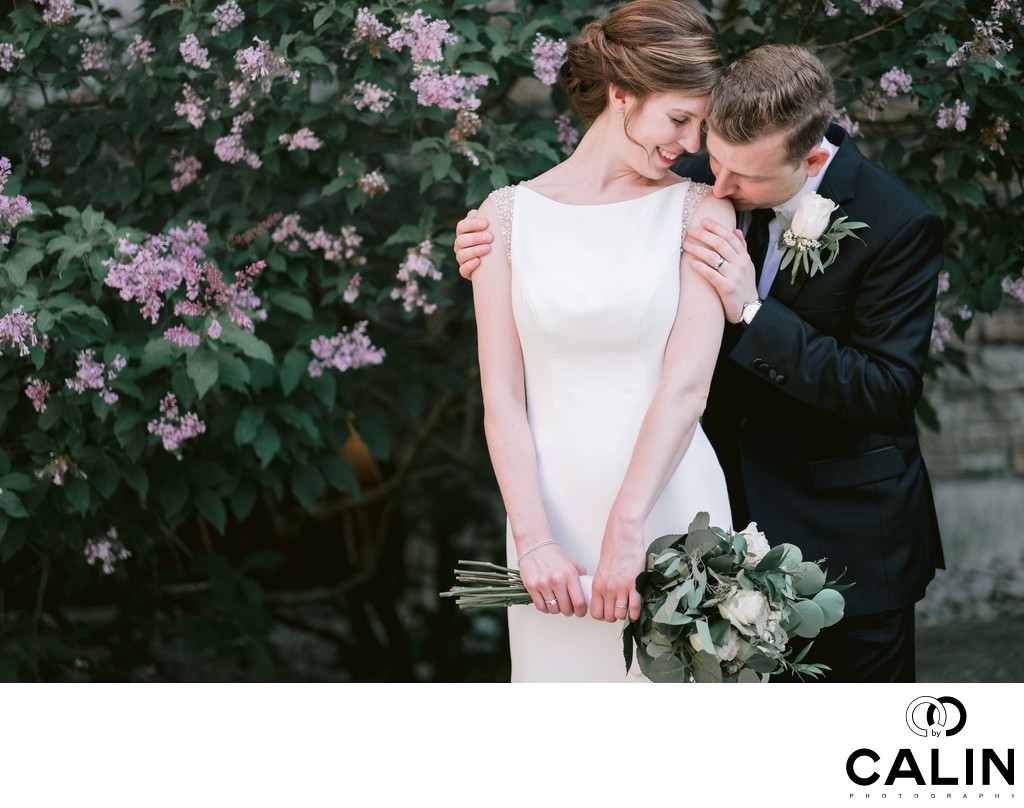
We had just wrapped a fast, efficient round of portraits and bridal party photos and I could feel that familiar shift: the couple’s shoulders dropped, their smiles became less “camera-ready,” and more real. I guided them a few steps toward a wall of lilacs—one of those Old Mill garden backdrops that looks cinematic without trying—because I wanted something that felt private even though we were only a short distance from the bustle of the day.
I didn’t ask for anything complicated. I simply placed them close, let the groom settle his hands naturally, and let the bride keep her bouquet where it would fall comfortably. When the pose feels like something they’d do even if I weren’t there, I know I’m in the right place. That’s when the expression changed—her smile turned inward, his focus narrowed to her—and the photograph basically made itself.
If you’re planning an Old Mill Toronto Wedding, this is exactly why I love building in a few “unscheduled” minutes: it’s often where the most honest frames live.
Technical Breakdown: Lens Choice, Light, and Composition
I captured this on a Canon R5 using a Canon RF L-series lens. I’m obsessive about pairing the R5 with RF L glass because the look is clean and consistent: strong micro-contrast, controlled flare, and that polished separation that doesn’t turn backgrounds into mush.
The light here is soft and diffused—either open shade or lightly overcast—so skin tones stay smooth and highlights don’t spike. With this kind of light, I can prioritize expression and connection instead of fighting harsh contrast. I positioned them so the lilacs sit behind and around them like a natural frame, keeping the couple as the brightest, most visually “weighted” part of the image.
Compositionally, I kept them centered and steady. This isn’t a frame that needs dramatic angles. The power comes from symmetry and calm: the groom’s dark suit anchors the left side, the bride’s dress and bouquet bring brightness and texture to the right, and the lilacs add a soft purple wash that reads as romantic without distracting.
Depth of field is intentionally shallow. I want you to feel the location, but I don’t want you to read every leaf. The background blur is there to simplify, not to show off. The result is a portrait that feels timeless—romance first, technique second.
Why This Is a Great Wedding Photograph (Unfiltered Critique)
This is a great wedding photograph because it has emotional clarity. There’s no confusion about what matters: the couple is close, relaxed, and genuinely connected. The groom’s embrace reads protective and calm, not posed or performative. The bride’s expression is warm and self-assured—she looks like she’s having a good day, not just “being photographed.”
It’s also great because the frame is visually quiet. A lot of wedding portraits fail because the photographer includes too much: cluttered backgrounds, busy lines, competing colors. Here, the lilacs create a soft environment, and the shallow depth of field edits the scene down to its essentials. That’s not an accident—it’s me deciding that the scene should support the emotion, not compete with it.
Technically, the image holds together because exposure and color are controlled. Whites stay clean (dress detail remains intact), skin tones stay natural, and the background purples/greens don’t contaminate faces. When a portrait is this simple, every technical weakness becomes obvious—so the fact that it feels effortless is precisely why it works.
If you like portraits that feel intimate but still show the venue, you’ll probably love the companion moment in Newlyweds Kiss Under the Veil at Old Mill Toronto—it leans even harder into romance while keeping the scene clean.
Post-Processing: How I Finished the Image (Step-by-Step, In Practice)
My postprocessing goal here was to keep it honest, refined, and dimensional—no gimmicks, no trendy color shifts that will age poorly. I started with a neutral baseline and then shaped the image in layers:
1) Global Color & Tone
I corrected white balance to keep the dress truly white while protecting skin tones from going too warm or too magenta (easy to do when lilacs are nearby). Then I adjusted overall exposure so the couple sits slightly brighter than the background, giving them priority without making it look “lit.”
2) Contrast, Curves, and Micro-Contrast Control
I refined contrast with a gentle curve: lifting midtones for flattering skin while keeping blacks rich enough that the groom’s suit looks deep and structured. I also controlled micro-contrast so faces stay smooth, but details like bouquet greenery and suit edges stay crisp.
3) Selective Masking (Where the Real Work Happens)
I used selective masks to subtly brighten faces and draw the eye exactly where I want it—eyes, cheeks, and the line of the embrace. I softened the background slightly (not blur—soften) so the lilacs remain recognizable but don’t pull attention away from expressions.
4) Skin Retouch & Texture Discipline
Retouching here is minimal and careful: I clean temporary distractions and even out tone gently, but I preserve natural texture. A wedding portrait should still look like the couple—just on their best day, with nothing distracting stealing the spotlight.
5) Final Polish
I finish with subtle sharpening on the couple (especially eyes and lash line), mild noise control if needed, and a restrained vignette so the edges fall away naturally. The vignette should feel like the scene, not like an effect.
What I Look For When Photographing Portraits at Old Mill Toronto
The Old Mill gives you texture and greenery, but the best portraits happen when you use those elements with intention. I look for: clean backgrounds, soft light, and a spot where the couple can forget I’m there for a second. That’s why lilacs, stone, and garden edges work so well—they’re beautiful without being chaotic.
If you want a more classic bridal-focused portrait at the same venue, this pairs perfectly with bridal portrait at Old Mill Toronto.