
Old Mill Toronto Wedding Details I Never Skip: Shoes, Bouquets, and the Calm Before the Ceremony
When I photograph an Old Mill Toronto Wedding, I’m always listening for the quiet moments that happen before the big ones. This is one of them: a deliberate pause where style, friendship, and anticipation line up perfectly—right down to the heels on stone.
How I made this frame—and why it matters in an Old Mill Toronto Wedding story
Just before the ceremony pace takes over, I pull the bridal party aside for a handful of images that do a specific job: they establish mood and they prove the day’s aesthetic is real, not just a Pinterest plan. At the Old Mill, that’s easy to do because the textures are already doing half the storytelling—the uneven stone underfoot, the soft outdoor light, the natural greenery nearby. I positioned the bridesmaids in a simple line and asked for one thing only: hold your bouquets naturally, settle your weight into your shoes, and breathe. That’s when the photograph becomes honest.
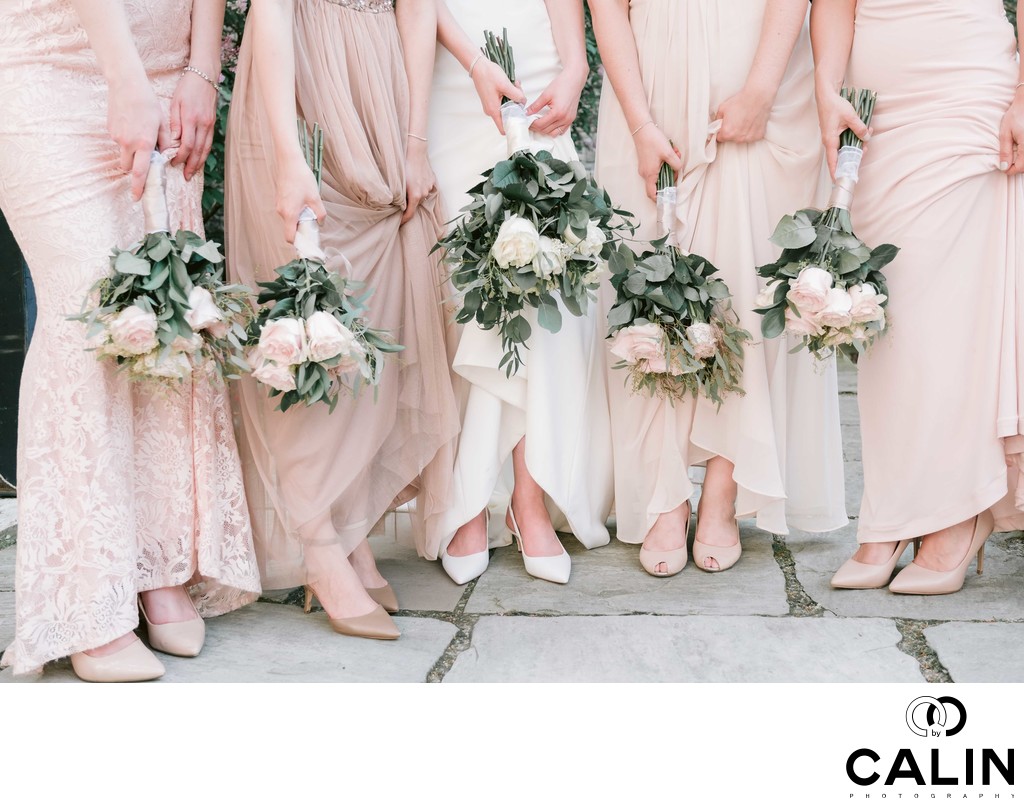
I’m not chasing faces here. I’m chasing signals: coordinated dresses, the rhythm of repeated bouquets, and the subtle confidence that shows up in posture. This image reads like a promise—everything is ready, everyone is present, and the ceremony is minutes away. The Old Mill setting supports that feeling because it’s refined without feeling sterile; it lets details look elevated without forcing them to look staged.
What’s actually in the photograph (and what I want you to notice first)
The frame focuses on the lower half of the bridesmaids: floor-length dresses in soft blush/beige tones, nude heels that visually unify the group, and bouquets built around pink and white roses with green foliage. The stone walkway anchors the whole scene with a neutral, textured base. The repetition is the point—multiple bouquets at the same height, multiple hems falling in parallel lines, multiple pairs of shoes stepping into the same day. The background stays understated and out of the way because I intentionally kept depth of field shallow enough that nothing competes with the pattern of dresses and florals.
Camera and lens choices: why I reached for Canon R5 + Canon RF L-series glass
I photographed this with my Canon R5 bodies, and I leaned on Canon RF-mount L-series lenses because they give me two things I need for wedding detail work: consistent color and reliable contrast, even when the light is gentle and low-drama. For this particular image, I shot it with a Canon RF 70-200mm f/2.8L IS lens. That focal range is perfect for compressing a line of people without making the scene feel cramped, and it lets me keep the background clean while I isolate the repeating details—bouquets, dress textures, and shoes.
The R5 files also give me latitude in post—especially in subtle tonal transitions (like blush fabric against pale skin and neutral stone) where lesser files can get muddy or overly magenta. I want the softness to feel intentional, not accidental.
Lighting, composition, and depth of field: the technique behind the calm
This is natural light, and the reason it feels flattering is that it’s soft and even—no harsh shadows slicing across dresses, no blown highlights on skin, no specular distractions off the shoes. I placed the bridesmaids so the light wrapped across them rather than striking from an extreme angle. The result is a clean exposure with controlled highlights and gentle midtones, which is exactly what you want for pastel palettes.
Compositionally, I’m using repetition as structure. The bouquets form a visual cadence across the top of the frame; the hems and shoes create a second cadence below. That symmetry makes the image feel organized, which subconsciously reads as “everything is under control.” Depth of field is shallow enough to separate the subjects from the environment, but not so shallow that the scene loses context—this is still clearly outdoors, still clearly grounded in the venue’s textures.
The moment behind the moment: what happened right before I clicked
While the couple handled final ceremony logistics, the bridesmaids were doing what great bridesmaids do: checking on each other, smoothing dress straps, adjusting grip on bouquets, making sure heels were comfortable enough for a long day. I watched the line tighten naturally—everyone finding their place without me micromanaging it. That’s when I stepped in and gave minimal direction. I didn’t want performance; I wanted readiness.
In an Old Mill Toronto Wedding, timelines can move quickly once guests arrive. This photograph is my way of slowing time down on purpose. It becomes a visual inhale—right before the ceremony exhale.
Why this is a great wedding photograph (and I’ll say it plainly)
This is a great wedding photograph because it’s emotionally accurate and technically disciplined at the same time. Emotionally, it captures unity without forcing a smile. You can feel the togetherness simply through coordination and proximity—friends aligned in support, literally standing with the bride. Technically, it’s great because nothing is fighting for attention: the exposure is balanced, the highlights are controlled, the sharpness is where it needs to be, and the color palette stays coherent from bouquet to dress to shoe.
Most importantly, it respects the intelligence of the viewer. It doesn’t explain the day; it suggests it. And suggestion is powerful—because it invites the couple back into the memory rather than handing them a loud, obvious summary.
Post-processing: the exact kind of restraint that makes details look expensive
My editing approach here is about refinement, not transformation. First, I neutralize overall white balance to keep blush tones looking like fabric—not like a pink filter. Then I do targeted HSL work: I tame magenta shifts in skin-adjacent areas and keep greens from the foliage natural rather than neon. Next comes tonal shaping: a gentle S-curve to add contrast without crushing shadow detail in the dress folds, and highlight recovery to preserve bouquet texture in the pale petals.
I also dodge and burn lightly—very selectively—so the bouquets read as the brightest “story” element without turning the dresses gray. Texture is handled with care: mild clarity on florals and stone for definition, while keeping skin and fabric smooth and believable (no plastic look). Finally, I apply lens corrections to maintain straightness and edge consistency, sharpen with a masked approach so only true detail gets sharpened, and finish with subtle noise control to keep the gradients in the dresses clean.
The goal is that you never notice the post-processing. You only notice that everything feels polished.
Where this image fits in the wider Old Mill Toronto Wedding coverage
I love pairing this kind of refined detail frame with the energy that inevitably shows up once the bridal party relaxes. If you want to see how the vibe shifts from composed to playful, explore the bridesmaids fun at Old Mill Toronto moments. And when the phones come out and the group starts documenting the day on their own terms, the story continues in bridesmaids take selfies at Old Mill Toronto.
But it all starts here: shoes planted, bouquets gathered, and the calm confidence that tells me we’re about to make photographs the couple will feel for years.